
Brahmarandhra: The Gateway of Supreme Consciousness

Table of Contents
Introduction
The word Brahmarandhra is derived from two Sanskrit roots:
“Brahma” — the Supreme Reality, Universal Consciousness, or the Creator.
“Randhra” — an opening, passage, or aperture.
Thus, Brahmarandhra literally means “the gateway to Brahman” — the subtle passage through which individual consciousness (Atman) connects with cosmic consciousness (Brahman).
It is located at the top of the head (the crown area) and corresponds to the Sahasrara Chakra in Yoga philosophy.
Focus Keywords:
Brahmarandhra
Sahasrara Chakra
Ayurveda and Consciousness
Kundalini Awakening
Brahmarandhra Meaning
Door of Liberation
Aatreya Ayurveda Lifestyle
Eleventh Gate (Ekadasha Dwara)
The Gate of Consciousness
Door of Life
Door of Liberation
Vedic and Upanishadic Perspective
In the Upanishads, Brahmarandhra is described as the door of liberation, through which the soul ascends to Brahman at the time of death.
Chandogya Upanishad (8.6.6)
“Eṣo’ntaḥ pure ātmā brahmā tasya eṣa sushirā eṣa brahmarandhraḥ.”
Meaning: Within the heart of man is the Self; the subtle opening called Brahmarandhra is the path to Brahman.
Katha Upanishad (2.3.16)
“Ardhamātreṇa kalpitaṃ brahmarandhreṇa niṣkramya…”
Meaning: The soul departs through the Brahmarandhra and merges into the infinite Brahman.
Hence, Brahmarandhra is called the Door of Liberation (Moksha Dwara).
Yogic Philosophy
In Yoga and Kundalini philosophy, Brahmarandhra corresponds to the Sahasrara Chakra, the thousand-petalled lotus at the crown of the head.
Location: Crown of the head (vertex).
Associated Chakra: Sahasrara (Crown Chakra).
Deity: Lord Shiva (Pure Consciousness).
Energy (Shakti): Supreme Divine Energy.
Role in Kundalini Awakening
When Kundalini Shakti, awakened from the base (Mooladhara Chakra), rises through all chakras and merges at the Sahasrara, the yogi attains Samadhi — a state of oneness with the Supreme.
This union at the Brahmarandhra signifies Self-realization (Atma–Brahma Aikya).
Ayurveda Perspective
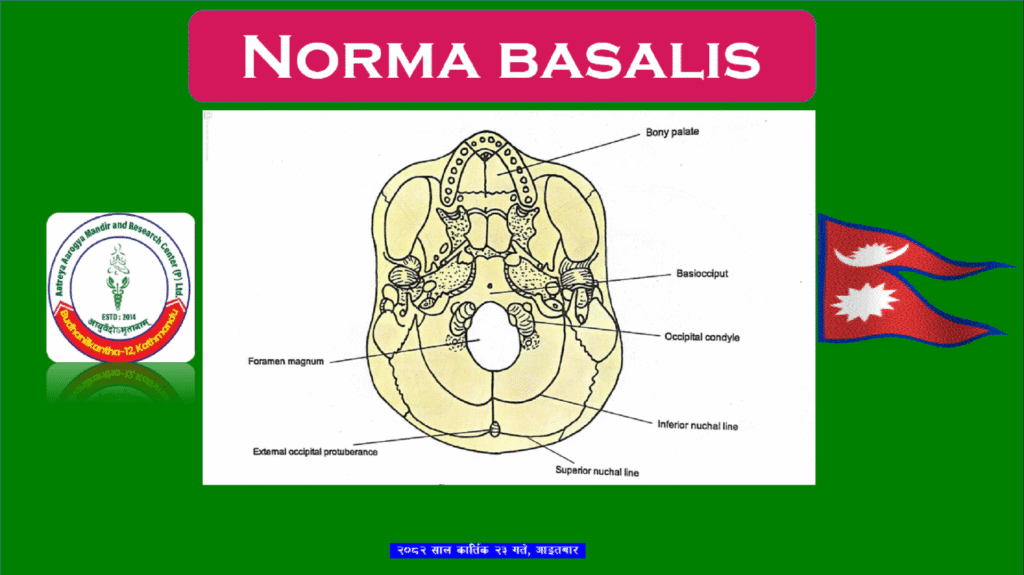
In Ayurveda, Brahmarandhra is recognized as one of the vital marma points (Shira Marma) — the most delicate and life-sustaining energy centers of the human body.
Sushruta Samhita, Sharira Sthana 6/28
“Ardhakapālamūrdhni brahmarandram nāma marmam.”
Meaning: “In the upper half of the head lies the marma known as Brahmarandhra.”
It is directly connected to Prana (life force) and Chetana (consciousness).
Injury to this point can cause instant loss of consciousness or death.
In newborns, this region remains soft and open (fontanelle), representing the channel of life energy.
Therapeutic Importance
Ayurvedic therapies like Shiro Abhyanga (head oil massage), Shirodhara, and Nasya work to balance the energy around Brahmarandhra.
It calms the mind, relieves insomnia, anxiety, and promotes deep mental relaxation.
Modern Anatomical and Scientific View
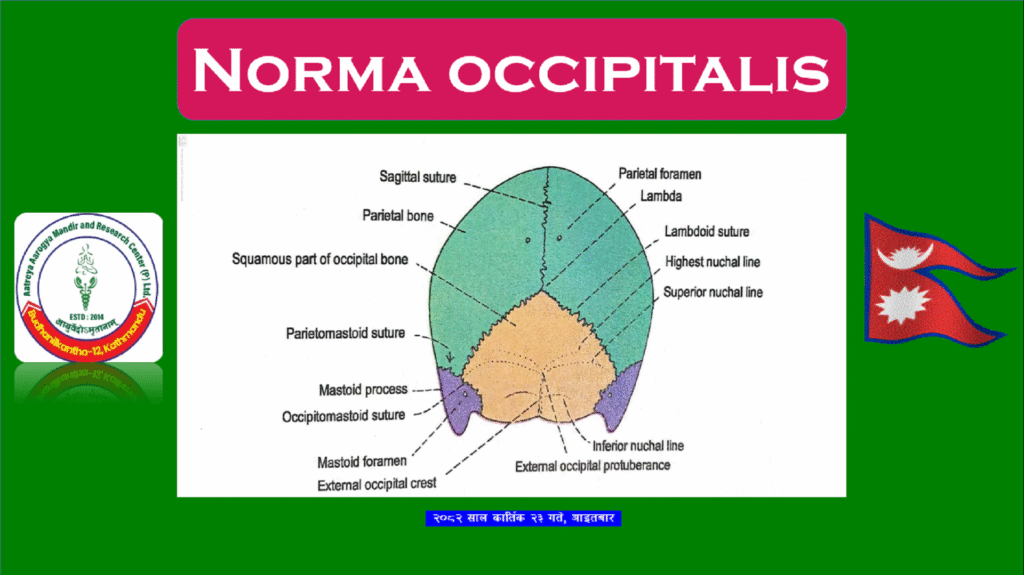
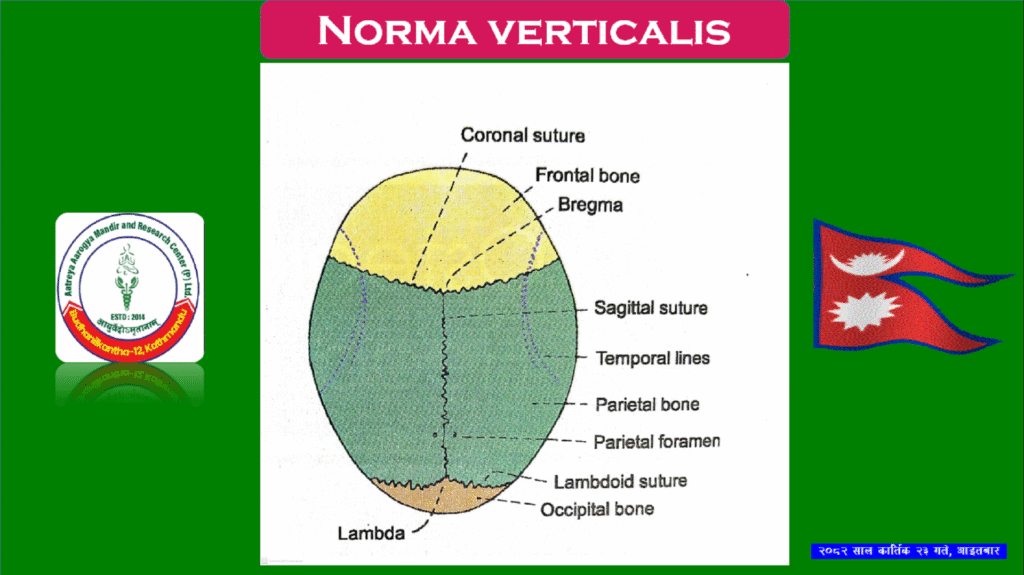
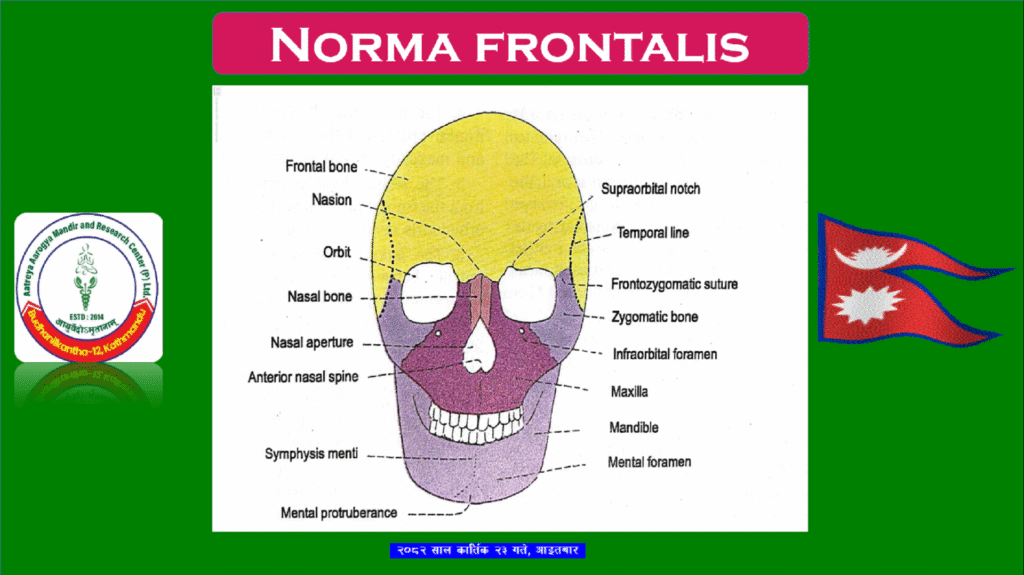
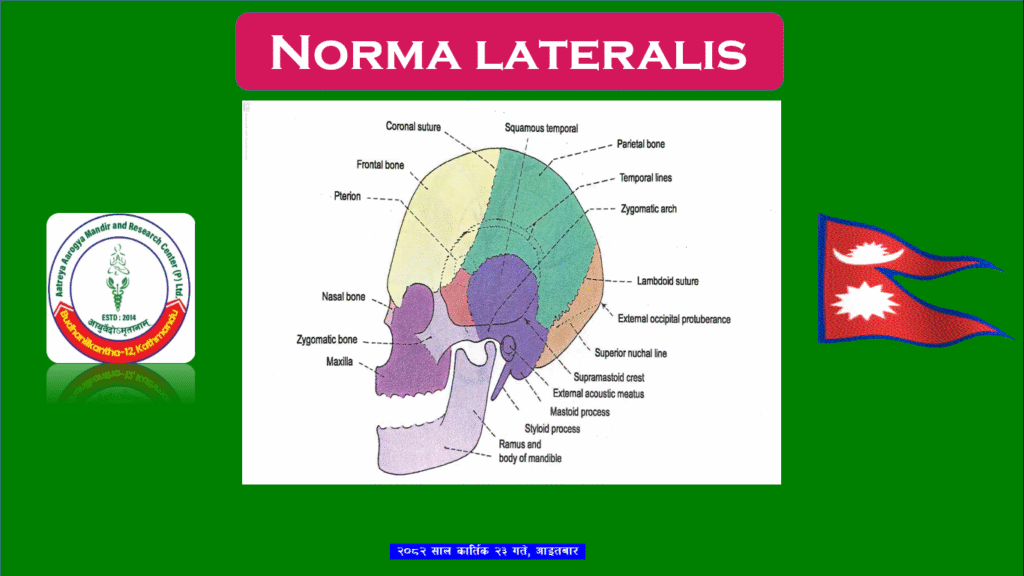
Modern anatomy correlates the Brahmarandhra with the anterior fontanelle (Bregma) – the soft spot on the skull of infants where cranial bones are not yet fused.
It closes around 18–24 months after birth.
This region connects energetically to the pineal gland, pituitary gland, and cerebral cortex — centers governing consciousness, hormonal balance, and higher awareness.
From a neuro-energetic perspective, it is a key site for energy exchange between the brain and the cosmos.
Tantric and Spiritual Meaning
In Tantra, Brahmarandhra is called the Eleventh Gate (Ekadasha Dwara) of the body.
The first nine gates are the physical openings – eyes, ears, nostrils, mouth, anus, and genital openings.
The tenth is the navel, and the eleventh is Brahmarandhra – the Gate of Consciousness.
When a yogi transcends through this gate during deep meditation, he attains the Turiya State — beyond waking, dreaming, and deep sleep — the state of pure awareness.
Meditative Practices
Meditating upon the Brahmarandhra or Sahasrara Chakra helps in:
Elevating consciousness,
Achieving mental peace and clarity,
Experiencing bliss, light, and unity with existence,
Attaining higher states of Samadhi.
This meditation opens the inner channel of divine energy (Amrita) and leads to spiritual awakening.
Life and Death in Ayurveda
Ayurveda teaches that –
During birth, the soul enters the body through the Brahmarandhra.
During death, the soul leaves the body through the same opening.
Hence, Brahmarandhra is both the Door of Life and the Door of Liberation.
Symbolic Meaning
Brahmarandhra represents:
The union of body, mind and spirit,
The meeting point of individual and cosmic consciousness,
The secret of birth and death,
The ultimate goal of yoga and meditation.
Conclusion
The Brahmarandhra is the most sacred, subtle, and mysterious point of human existence —
the meeting place of Prana and Consciousness,
the bridge between mortal and divine,
and the doorway to liberation (Moksha).
It signifies the awakening of higher awareness – the realization that the ultimate healing and enlightenment arise not from external medicine, but from awakening the divine consciousness within.
Aatreya Aarogya Mandir Message
Aatreya Ayurveda Lifestyle emphasizes harmony of body, mind, and consciousness.
Awareness of Brahmarandhra reminds us that true healing begins not from outside,
but from awakening the divine energy within.
“He who dwells in awareness at the crown, dwells in Brahman itself.”
The anatomical and philosophical relationship between the Fontanelle, Kapal ko Bhoomari (Crown Whirl) and Brahmarandhra – clearly linking modern anatomy, Ayurveda and Yoga philosophy.
Discover the ancient wisdom of Brahmarandhra, the crown gateway of divine consciousness described in the Vedas, Upanishads, Ayurveda, and Yoga. Learn how it governs life, death, meditation, and spiritual awakening in the Aatreya Ayurveda Lifestyle.
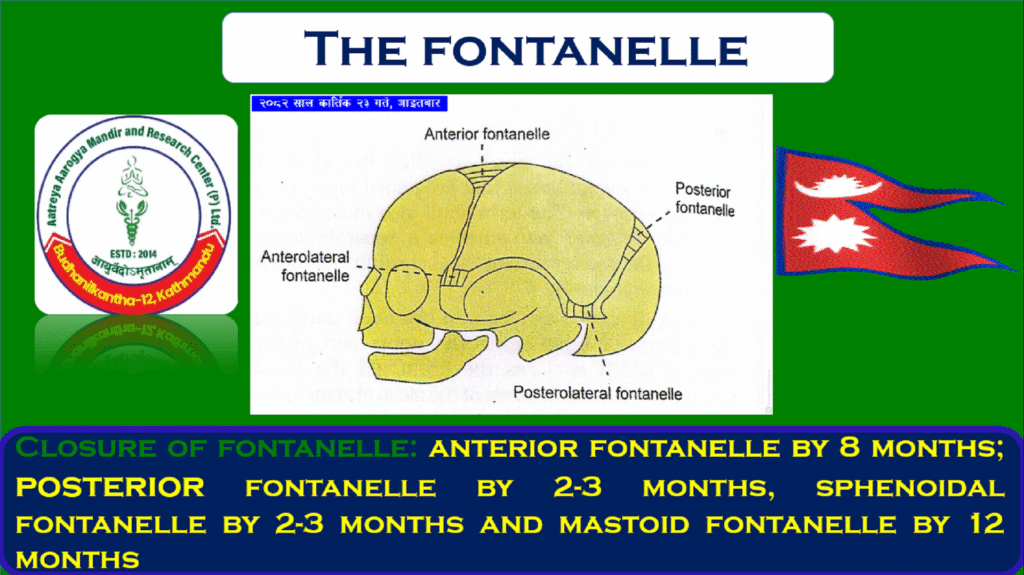
A fontanelle is a “soft spot” on an infant’s head where the skull bones have not yet fused, allowing for brain growth and for the head to change shape during birth. These are covered by a tough membrane and are normal, but can be monitored for signs of medical issues, such as bulging or sunken fontanelles. The most prominent ones are the large, diamond-shaped anterior fontanelle at the front of the head and the smaller, triangular posterior fontanelle at the back.
What fontanelles are
Soft spots: They are the areas where the bones of the skull have not yet grown completely together.
Tough membranes: Despite feeling soft, the areas are covered by a tough, fibrous membrane.
Normal and important: They are a normal part of infant development and crucial for growth.
Their purpose
Birth: They allow the skull to compress and shift as the baby passes through the birth canal.
Growth: They provide space for the brain to grow rapidly during the first couple of years of life.
Key fontanelles
Anterior fontanelle: The larger, diamond-shaped soft spot at the top and front of the baby’s head.
Posterior fontanelle: The smaller, triangular soft spot at the back of the baby’s head.
What to know
Touching them is safe: It is safe to gently touch, wash, and put hats or hoods on your baby’s fontanelles.
Closing time: The posterior fontanelle typically closes around 2-3 months, while the anterior fontanelle usually closes between 18 and 30 months.
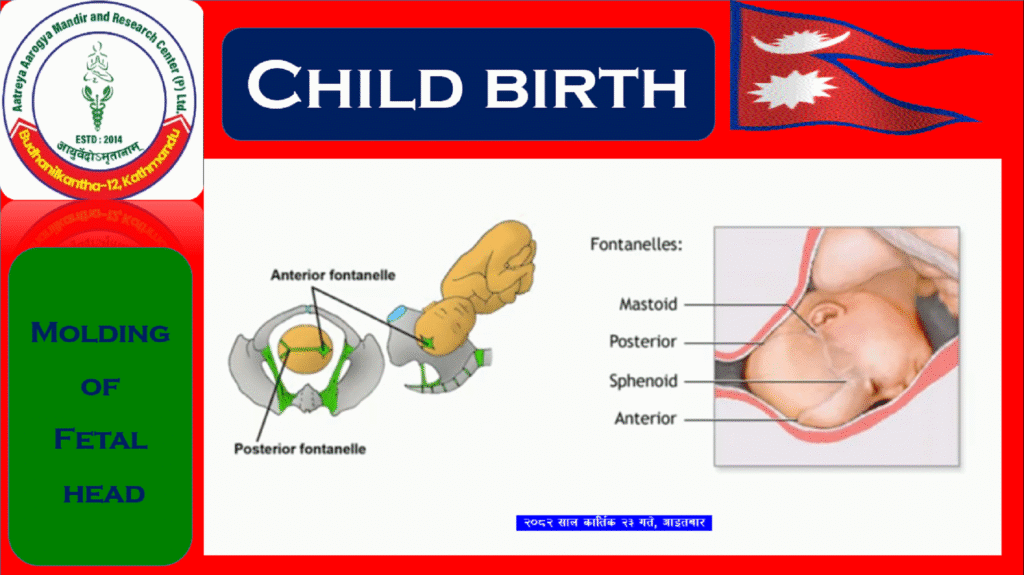
Fontanelle (Modern Anatomical Perspective)
Location:
In newborns, the anterior fontanelle is the soft, membranous area at the top of the head – between the frontal and parietal bones (called the Bregma region).
It normally closes between 18 to 24 months after birth.
Function:
Allows flexibility of the skull during childbirth.
Facilitates brain growth in early life.
Serves as a sensitive energy-exchange zone between the internal brain and the external environment – a biological reflection of subtle energy flow.
Kapal ko Bhoomari (Crown Whirl / Hair Whorl)
Location:
In adults, the hair whorl or spiral at the crown of the head (where hair naturally circles) marks the same topmost cranial area.
It is usually positioned exactly above or around the Brahmarandhra point.
Significance:
Anatomically, it marks the convergence of skin, fascia, and cranial sutures.
Energetically, it is believed to be a vortex of pranic energy — the physical indicator of the crown chakra zone.
Ancient Ayurveda texts refer to this area as “Shira Marma” or “Chetana Sthana” — the seat of consciousness and vitality.
Brahmarandhra (Yogic and Ayurveda Concept)
Location:
Situated at the crown of the head (vertex) — the same region as the fontanelle and Bhoomari.
Subtly corresponds to the Sahasrara Chakra (the thousand-petalled lotus).
Significance:
Regarded as the Gateway of Life and Liberation (Moksha Dwara).
The soul (Atman) is said to enter and exit the body through this gateway.
Connected to the pineal gland, pituitary gland, and cerebral cortex — centers governing consciousness and higher awareness.
Injury or disruption to this point (as per Ayurveda’s Sira Marma) can lead to loss of consciousness or death.
Anatomical–Philosophical Correlation
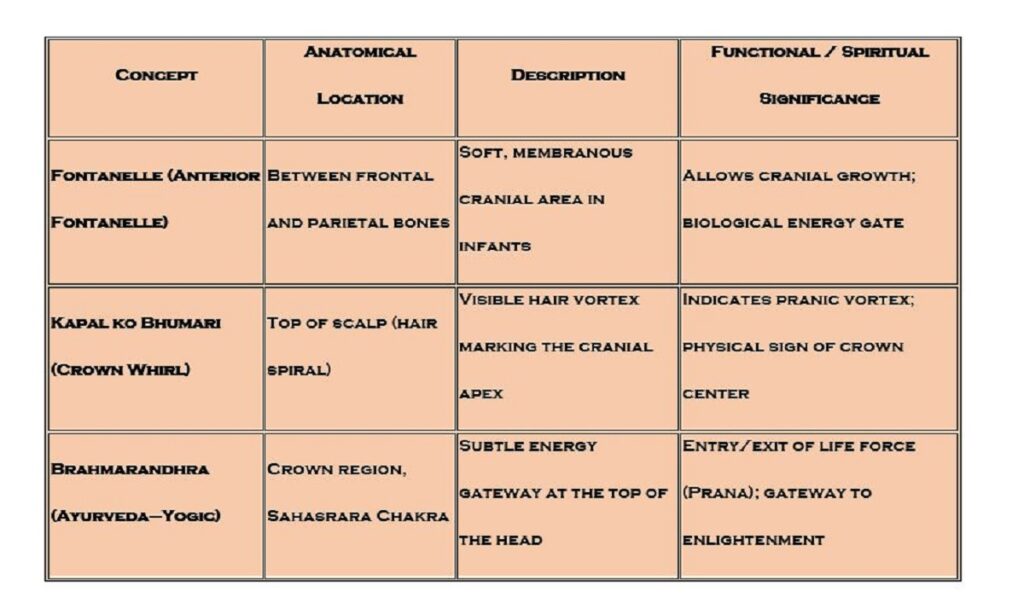
Integration of Science, Ayurveda and Yoga
Modern science views the crown region as a structural and developmental zone (fontanelle).
Ayurveda interprets it as a Marma Sthana controlling Prana and Chetana (vital energy and consciousness).
Yoga philosophy identifies it as the Brahmarandhra, the divine gateway where individual consciousness unites with universal consciousness.
Hence, they represent three dimensions of one reality:
Fontanelle – the physical opening
Kapal Bhumari – the visible spiral of energy flow
Brahmarandhra – the spiritual gateway of consciousness
The Tradition of Keeping a “Tuppi” (Hair Tuft) at the Bhumari – Its Scientific and Spiritual Significance
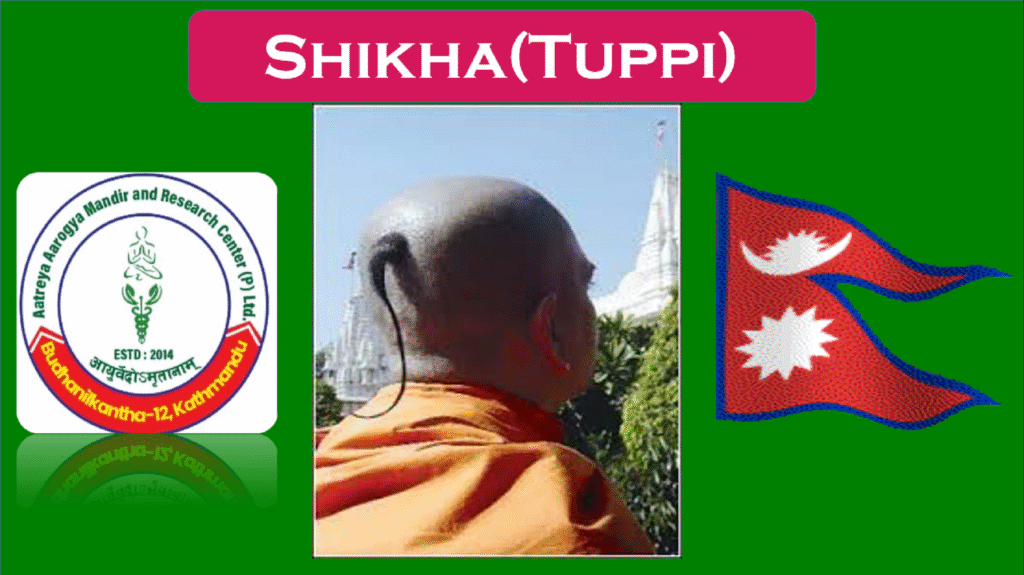
In ancient Vedic culture, men – especially Brahmacharis, scholars, and priests — traditionally kept a “tuppi” (or shikha), a small tuft of hair at the bhumari, the crown whirl of the head.
Scientific and Anatomical Basis
The bhumari or crown region lies directly over the Brahmarandhra, a highly sensitive area associated with the pineal gland, pituitary gland, and cerebral cortex.
This area governs consciousness, hormonal balance, and energy regulation.
Keeping a tuft of hair here acts as a natural insulator and protector for the Brahmarandhra – shielding it from excessive heat, sun exposure, and external energy disturbances.
The spiral pattern of the hair enhances bioelectric energy circulation in the crown area, helping maintain mental clarity and spiritual balance.
Spiritual and Yogic Meaning
The tuppi marks the seat of divine consciousness (Sahasrara Chakra) – the point where individual awareness connects with universal consciousness.
During meditation, it helps the practitioner maintain focus at the crown and preserve ojas (vital energy).
Symbolically, it represents discipline, purity and connection with higher wisdom.
In Summary
The practice of keeping a tuppi at the bhumari is not merely a cultural symbol but a scientifically sensible and spiritually meaningful tradition.
It protects the most vital energy center of the human body – the Brahmarandhra – while reminding one to live in constant awareness of the higher self.