
Ayurveda: The Science of Life and the Eternal Philosophy of Health
Table of Contents
Introduction
Ayurveda is not merely a system of medicine — it is a complete philosophy of life. The term “Ayurveda” is derived from two Sanskrit words: Aayu (life) and Veda (knowledge), meaning “the knowledge of life.” Ayurveda does not limit itself to curing diseases; it aims at maintaining harmony of body, mind, senses, and soul, thus ensuring total well-being. It considers health as the foundation for achieving the four goals of life — Dharma, Artha, Kama, and Moksha.
Origin and History
The roots of Ayurveda go back to the Vedic era. The knowledge of herbs, healing, and preventive health is mentioned throughout the Rigveda, Yajurveda, Samaveda, and Atharvaveda. Among these, Atharvaveda is considered the primary source of Ayurveda wisdom.
It is believed that Lord Brahma was the originator of Ayurveda, who passed this knowledge successively to Daksha Prajapati → Ashwini Kumaras → Indra → Dhanvantari → Charaka, Sushruta, and Vagbhata.
While Sushruta contributed surgical sciences, Charaka expanded internal medicine, and Vagbhata unified the entire Ayurveda philosophy into a comprehensive form.
Fundamental Principles of Ayurveda

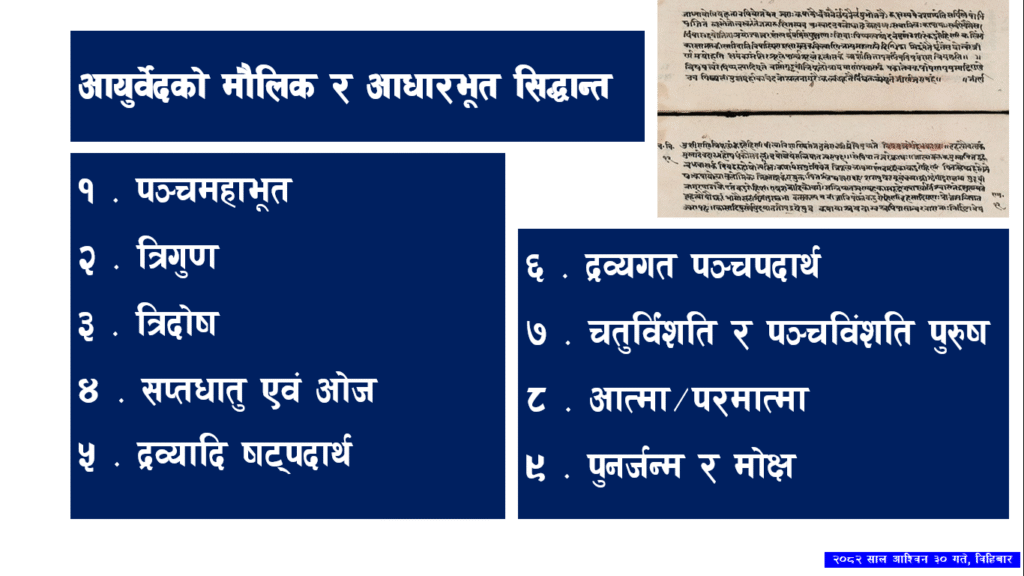
Ayurveda is built upon profound philosophical foundations, mainly:
Panchamahabhuta Siddhanta – The theory of five great elements: Earth (Prithvi), Water (Aapa), Fire (Teja), Air (Vayu), and Ether (Aakasha).
Tridosha Siddhanta – The concept of three vital humors: Vata, Pitta, and Kapha, which regulate all physiological functions.
Sapta Dhatu Siddhanta – The seven body tissues: Rasa, Rakta, Mamsa, Meda, Asthi, Majja, and Shukra.
Tri-mala Siddhanta – The three waste products: urine, feces, and sweat.
Agni Siddhanta – The concept of digestive and metabolic fire, which governs nutrition, energy, and transformation.
Balance among these factors signifies health, while imbalance causes disease.
Definition of Health
According to Sushruta Samhita:
“Samadoshah samagnischa samadhatumalakriyah |
Prasannatmendriyamanaḥ swastha ityabhidhiyate ||”
(Su. Su. 15/41)
A person is considered healthy when the doshas, digestive fire, tissues, and excretory functions are balanced, and when the mind, senses, and soul are in a state of bliss.
The Eight Branches of Ayurveda (Ashtanga Ayurveda)
Kaya Chikitsa – Internal Medicine
Shalya Tantra – Surgery
Shalakya Tantra – ENT & Ophthalmology
Kaumarbhritya – Pediatrics, Gynaecology & Obstetrics
Agada Tantra – Toxicology
Bhuta Vidya – Psychiatry & Spiritual Healing
Rasayana Tantra – Rejuvenation Therapy
Vajikarana Tantra – Aphrodisiac & Reproductive Health
These eight branches encompass all aspects of physical, mental, and spiritual health.
Ayurveda Lifestyle Philosophy
The central aim of Ayurveda is twofold:
Swasthasya Swasthya Rakshanam – To preserve the health of the healthy.
Aturasya Vikara Prashamanam – To cure the diseases of the sick.
For this, Ayurveda emphasizes living in harmony with nature through daily and seasonal routines:
Dinacharya (Daily Routine): Rising at Brahmamuhurta, cleansing, exercise, oil massage (Abhyanga), meditation, and mindful eating.
Ritucharya (Seasonal Routine): Adjusting diet, clothing, and habits according to seasonal changes.
Sadvritta (Code of Conduct/Do’s and Don’ts for healthy living): Living a moral life — truthfulness, compassion, forgiveness, and self-control.
Achara Rasayana (Behavioral Rejuvenation): Respect for elders and teachers, positive thinking, and virtuous behavior.
Ayurveda Nutrition (Aahara Siddhanta)
Ayurveda regards food as the first medicine.
“Aaharaḥ praninam prathamam aausadham.”
Food itself is the foremost medicine.
Every food has unique properties based on Rasa (taste), Guna (quality), Virya (potency), Vipaka (post-digestive effect), and Prabhava (specific action).
Ayurveda also recognizes Sattvic, Rajasic, and Tamasic diets, which influence mental and emotional states.
Pathogenesis of Disease (Samprapti)
Disease arises when there is disharmony between body, mind, and soul.
Irregular diet, improper behavior, environmental factors, and psychological disturbances lead to vitiation of Doshas.
The diagnostic approach in Ayurveda involves the Nidana Panchaka — Cause, Premonitory Signs, Symptoms, Palliative Factors, and Pathogenesis.
Ayurveda and Modern Science
Ayurveda complements modern medicine through its holistic and preventive principles:
Rasayana therapy parallels anti-aging and immunomodulatory science.
Panchakarma aligns with detoxification and metabolic reset concepts.
Satvavajaya Chikitsa resembles modern psychotherapy and mindfulness.
Thus, Ayurveda forms the foundation of Integrative Medicine – merging ancient wisdom with modern evidence.
The Need for Ayurveda in the Modern World
Today, the world faces an epidemic of lifestyle-related disorders – diabetes, hypertension, obesity, and depression.
The primary cause: unhealthy lifestyle.
Ayurveda offers a solution through the philosophy of “Lifestyle as Medicine.”
“If lifestyle can cause disease, lifestyle can also cure it.”
Aatreya Aarogya Mandir & Research Center
Location & Identity
Situated in Budhanilakantha-12, Kathmandu, Nepal.
It is both a clinical hospital / Ayurveda treatment center and a research institution.
Medical Director is Dr. Buddhi Prasad Paudel, MD (Ayurveda, Kayachikitsa / internal medicine), with over 30 years of experience.
Services Offered
Panchakarma (detoxification / purification treatments) and other classical therapies: Kaya Chikitsa, Manas Chikitsa (mental health), Rasayana (rejuvenation), herbal pharmacy etc.
Specialized treatments for chronic conditions: non-communicable diseases (NCDs) like diabetes, hypertension, obesity, thyroid, asthma; also digestive, musculo-skeletal, skin issues, etc.
Lifestyle coaching: dietary counselling, Ayurveda lifestyle awareness, spiritual / psychosocial counselling.
Clinical & Research Focus
Emphasis on combining classical Ayurveda traditions with contemporary public health needs.
Engages in documenting and publishing research; aiming for high-level academic recognition.
Training & educational programs: workshops, certification, collaborations with institutions like LDTA (Local Development Training Academy), NASC etc.
Vision / Mission
Their mission includes establishing Ayurveda Lifestyle (i.e. preventive & promotive health) as a standard.
They appear to be strongly grounded in Vedic / classical Ayurveda principles while adapting to local Nepali culture and current lifestyle disease burdens.
Reputation & Feedback
Reviews are positive: people note authentic Ayurvedic care, competent diagnosis, and compassionate environment.
The center seems to be well known in Nepal among those seeking Ayurveda / lifestyle medicine.
Aatreya Ayurveda Lifestyle
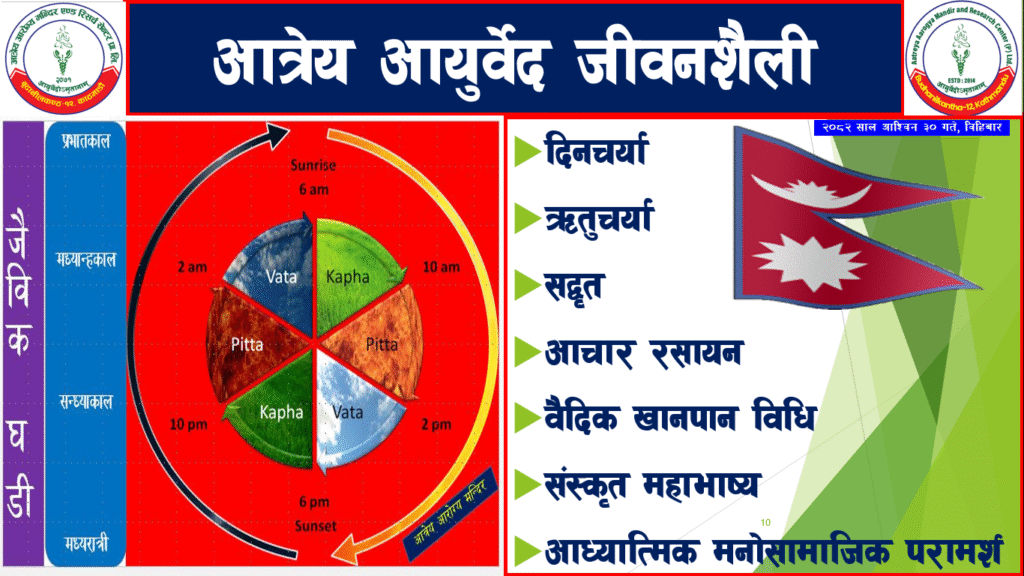
This is the lifestyle model promoted by Aatreya Aarogya Mandir, especially through Dr. Buddhi Prasad Paudel. It aims to provide a holistic, preventive / promotive health framework. Some details:
Core Components / Pillars
Based on public descriptions, the Lifestyle model has seven key pillars. These are:
Dinacharya (Daily Routine): Rise early (Brahmamuhurta), oral hygiene, bathing, yoga / pranayama, meditation, balanced meals, proper sleep.
Ritucharya (Seasonal Regimen): Adjust diet, behavior, lifestyle as per the seasons; preventive adaptation to seasonal changes
Aachara Rasayana (Behavioral / Ethical Rejuvenation): Virtuous behaviour, ethical conduct, moral discipline, self-control, compassion etc., for rejuvenation of body & mind.
Sadvritta (Moral Discipline & Social Ethics): Living in truth, humility, hygiene (both personal and environmental), responsibility, respect etc.
Vedic Dietary Habits: Focus on traditional / Sattvik food, appropriate eating patterns (Pathya / Apathya), food seasonality, balancing taste, digestion etc
Sanskrit Mahabhashya (Philosophical & Linguistic Foundation): Revival or study of classical texts, logic, possibly mantras or philosophical understanding; this pillar emphasizes the knowledge base of Ayurveda in Sanskrit tradition.
Spiritual & Psychosocial Counseling: Integration of meditation, mantras, introspection, counseling to manage stress, emotional / mental health.
Sanskrit Mahabhashya: Mantra and More
Goals & Benefits
To prevent / reduce non-communicable diseases (NCDs) through lifestyle correction rather than only treating symptoms.
To promote longevity, inner vitality, well-being in body, mind and spirit.
Making Ayurveda accessible and acceptable to modern people in Nepal: culturally relevant, locally grounded.
Some Strengths / Distinctive Features
From what can be seen:
Strong leadership by someone who has both deep classical Ayurveda training and experience in public health policy (Dr. Paudel). This helps bridge traditional and modern.
Clear ambition to integrate research and document outcomes, not just practice. This helps in credibility.
The lifestyle model is holistic, covering ethics, behavior, food, spiritual and psychosocial aspects—not only physical therapies.
Good local presence and positive user feedback.
Focus on chronic/modern lifestyle diseases which are a major burden and somewhat underserved by conventional systems in many places.
Possible Challenges / Things to Watch Out For
While much is positive, no system is without challenges. Some that might be relevant (these are speculative based on general knowledge, not specific confirmed issues):
Ensuring consistency and standardization in therapies and outcomes, especially if many practitioners are involved.
Research – publishing in peer-reviewed international journals, and having data to back efficacy. They seem working in that direction. Awareness among public: Ayurveda lifestyle is rich but people may find it hard to adhere to all pillars (diet, daily routines etc.) amid modern life demands.
Regulatory or quality control issues for herbal medicines, safety, interactions etc.
Fundamental Principles
Ayurveda, the eternal science of life, is not merely a system of medicine but a comprehensive philosophy that embraces body, mind, and consciousness. It is founded on certain eternal and universal truths, known as Mula Siddhānta or fundamental principles, which explain the existence, structure, and function of all living and non-living entities. These principles form the scientific and philosophical basis upon which Ayurveda diagnosis, prevention, and treatment are built.
Panchamahabhuta – The Five Great Elements

The universe, including the human body, is composed of five basic elements: Aakasha (Ether/Space), Vayu (Air), Teja (Fire), Jala (Water), and Prithvi (Earth).
These Mahābhūtas represent the building blocks of creation. Each element possesses distinct qualities and functions:
Aakasha (Ether) gives space for existence and movement.
Vayu (Air) represents motion and communication.
Teja (Fire) governs transformation, metabolism, and perception.
Jala (Water) symbolizes cohesion and fluidity.
Prithvi (Earth) signifies stability, structure, and strength.
In the human body, these elements exist in varied proportions, forming the foundation for Doshas, Dhatu, and Mala.
Tridosha – The Three Biological Humors

The dynamic forces that govern all physiological and psychological functions in the body are known as Vata, Pitta, and Kapha.
Vata Dosha (derived from Ether and Air) governs movement, communication, respiration, and elimination.
Pitta Dosha (Fire and Water) controls digestion, metabolism, vision, and intellect.
Kapha Dosha (Water and Earth) provides stability, lubrication, and endurance.
The equilibrium of these three Doshas ensures health (Svasthya), while their imbalance leads to disease (Vyadhi). Thus, maintaining Tridosha balance is the central goal of Ayurveda therapy and lifestyle.
Triguna – The Three Mental Qualities

Beyond the physical body, Ayurveda recognizes the mental and spiritual components of life through the theory of Triguna:
Sattva,
Rajas, and
Tamas.
Sattva denotes purity, clarity, harmony, and wisdom.
Rajas signifies passion, activity, and restlessness.
Tamas represents inertia, ignorance, and darkness.
The quality of one’s mind and consciousness depends on the predominance of these Guna. Sattva leads to peace and enlightenment, while excessive Rajas and Tamas lead to mental disturbance and ignorance. Ayurvedic psychology aims to cultivate Sattva through diet, conduct, meditation, and moral discipline.
Sapta Dhatu and Ojas – The Seven Body Tissues and Vital Essence
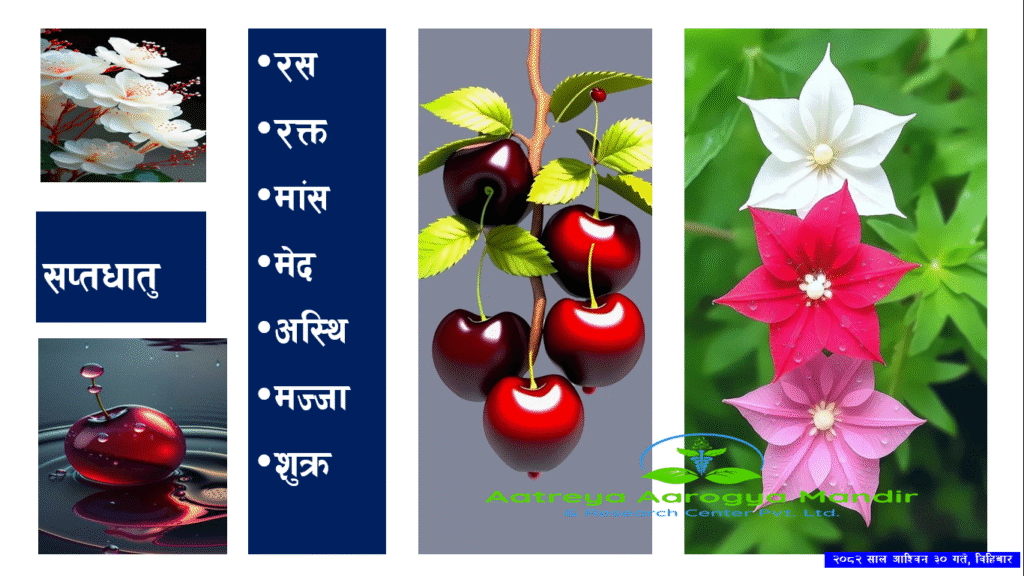
The human body is nourished and maintained by seven Dhatu:
Rasa (Plasma),
Rakta (Blood),
Mamsa (Muscle),
Meda (Fat),
Asthi (Bone),
Majja (Marrow/Nervous tissue), and
Shukra (Reproductive tissue).
Each Dhatu supports the next in a sequential process of nourishment. The ultimate essence of all Dhatu is Ojas, which represents vitality, immunity, and the subtle energy of life.
Para Ojas sustains consciousness and is fixed in the heart.
Apara Ojas circulates throughout the body, maintaining vigor and resistance.
When Ojas is diminished, the individual becomes weak and vulnerable to disease.
Dravyadi Shata Padartha – Six Fundamental Categories of Existence
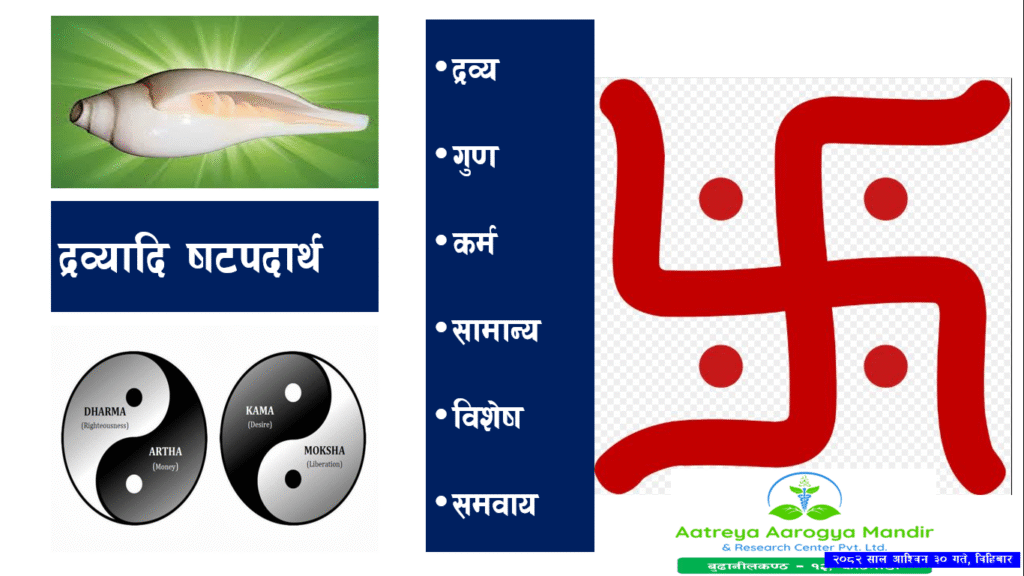
According to Ayurveda, all knowledge and matter can be understood through six philosophical categories:
Dravya (Substance),
Guna (Quality),
Karma (Action),
Samanya (Similarity),
Vishesha (Dissimilarity), and
Samavaya (Inherence).
These principles explain the interaction between body and environment. Dravya serves as the carrier of qualities (Guna) and actions (Karma). The concepts of Samanya and Vishesha are applied in treatment — similarity increases a property, while dissimilarity decreases it. This forms the logical foundation for Ayurveda therapeutics.
Dravyaguna Pancha Padartha – Five Attributes of a Substance

In pharmacology (Dravyaguna Vigyana), every medicinal or dietary substance possesses five attributes:
Rasa – Taste (Sweet, Sour, Salty, Pungent, Bitter, Astringent).
Guna – Qualities (e.g., heavy/light, hot/cold, dry/oily).
Virya – Potency or energy (cooling/heating).
Vipaka – Post-digestive effect (final metabolic transformation).
Prabhava – Specific or unique effect that cannot be explained by other properties.
These five parameters are used to determine the action, indication, and contraindication of any substance in Ayurveda treatment.
Chaturvimshati and Panchavimshati Purusha – 24 and 25 Elemental Compositions
The Sankhya philosophy describes human creation through 24 principles, which include the five elements, five sense organs, and five motor organs, five objects of perception, mind, intellect, ego, and Prakriti.
Ayurveda adds the Aatma (Soul) as the 25th element, forming the Panchavimshati Purusha.
This represents the complete human being – a combination of body, mind, and soul – the microcosm reflecting the macrocosm.
Aatma and Paramatma – The Individual and Supreme Soul
Ayurveda upholds that life is not possible without the presence of Aatma (individual consciousness). It animates the body, experiences pleasure and pain, and undergoes the journey of birth and death.
Paramatma is the supreme universal consciousness, the ultimate reality that pervades all existence.
When the individual soul realizes its unity with the supreme, true liberation (Moksha) is attained.
Punarjanma and Moksha – Rebirth and Liberation
Ayurveda accepts the doctrine of Punarjanma (Rebirth) and the ultimate goal of Moksha (Liberation).
Every action (Karma) leaves an imprint that determines the circumstances of future births. Through righteous conduct (Sadvritta), spiritual discipline, and realization of the self, one can transcend the cycle of birth and death, attaining freedom and eternal peace.
Conclusion
It is not an ancient relic; it is a timeless science of life — relevant and necessary for modern humanity.
It teaches the art of living in harmony with oneself and nature.
Those who follow its principles not only remain disease-free but also attain a blissful and purposeful life.
“Shariram adyam khalu dharmasadhanam.”
“The body is the foundation for all virtues; preserving it is the highest duty.
The Mula Siddhanta of Ayurveda are not limited to theoretical understanding; they are practical tools for harmonizing body, mind, and spirit.
By aligning one’s life with these natural and universal principles — through proper diet, conduct, and consciousness — one attains holistic health, longevity, and ultimately, liberation.
Ayurveda thus stands as a timeless science that reveals the profound connection between the individual and the cosmos — a journey from the physical to the spiritual, from the limited self to the infinite truth.