
Aajapa Japa Mantra: The Timeless Discipline of Breath, Awareness and Divinity
Table of Contents
Introduction


The human body is an extraordinary and rare gift. When used according to the wisdom of the scriptures, it can lead one toward Brahma realization – the realization of the Supreme Consciousness. Among the many spiritual disciplines prescribed, Aajapa Japa is considered one of the most accessible and powerful practices.
Through this sacred technique, one realizes the infinite grace of the Divine and learns how to maintain balance in body, mind and soul. This article explores the physical, mental, social and spiritual effects of Aajapa Japa, along with its scientific relevance, modern research findings, and practical ways to integrate it into daily life.
In this fast-paced modern world filled with noise, deadlines, and distractions, human beings have forgotten their original rhythm of existence – the gentle pulse of awareness that flows through every breath. Yet, ancient sages and seers of the Vedic and Ayurveda traditions designed subtle disciplines that reconnect us with this natural harmony. One such profound gift is the Aajapa Japa Mantra – a continuous, effortless remembrance of the Divine through the flow of breath.
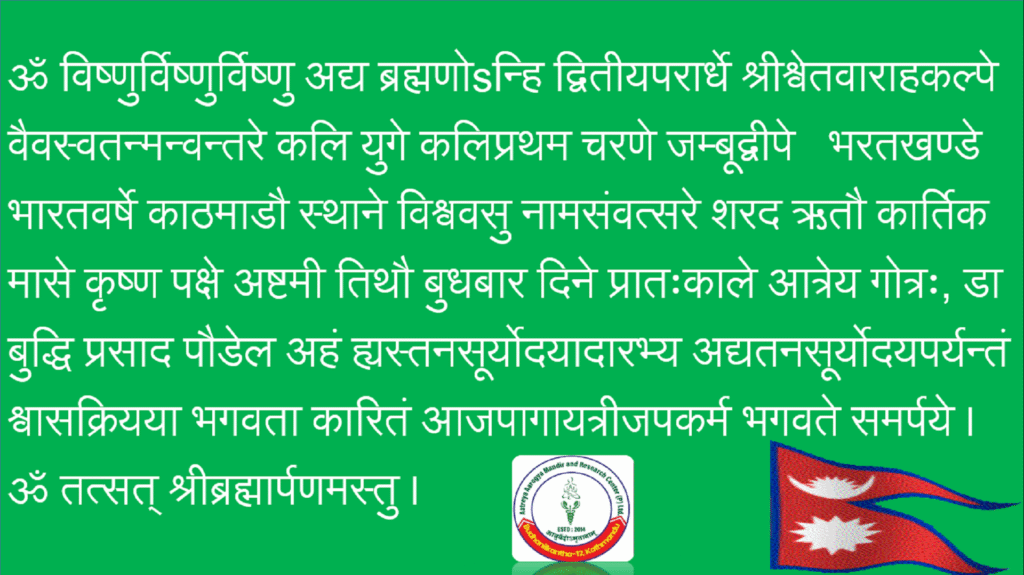
The mantra you have cited – is a beautiful, complete invocation that combines cosmological, geographical, personal, and temporal consciousness with divine remembrance. It represents not merely a prayer but a living connection between the self, breath, time, and the universe.
In this article, we shall explore:
The philosophical and scientific meaning of Aajapa Japa,
The benefits of this mantra on body, mind, and soul,
Its role in Ayurveda, Yoga, and modern psychological health,
And how this ancient practice can guide today’s humans toward peace, harmony, and holistic health.
Meaning and Context of the Mantra

The mantra begins with the sacred invocation “Om Vishnu Vishnu Vishnu”, symbolizing the all-pervading consciousness (Vishnu meaning “one who pervades all”).
The subsequent section situates the practitioner within the vast cosmic framework:
The present Kalpa (cosmic eon),
The Manvantara (era of Manu),
The Yuga (epoch – Kali Yuga),
The continent (Jambudveepa),
The region (Bharata Khanda, Bharatavarsha),
The specific place (Kathmandu),
The year, season, month, lunar phase, and weekday,
Followed by name and Gotra (lineage) of the practitioner.
By mentioning these details, the practitioner consciously aligns the microcosm (individual) with the macrocosm (universe). It is a moment of awakening — to time, place, ancestry, and divine connection.
The mantra ends with:
“Ajapa Gayatri Japa Karma Bhagavate Samarpaye, Om Tat Sat, Sri Brahmarpanamastu”
meaning, “I offer the practice of Ajapa Gayatri Japa, which continues effortlessly through my breath, to the Divine. Om Tat Sat — may this act be an offering to Brahman (the Supreme Reality).”
Thus, this mantra is both an offering and an awakening — a ritual of presence, breath, and devotion.
What is Aajapa Japa?
The term Aajapa Japa comes from Sanskrit:
Aajapa means “the Japa (repetition) that happens without effort.”
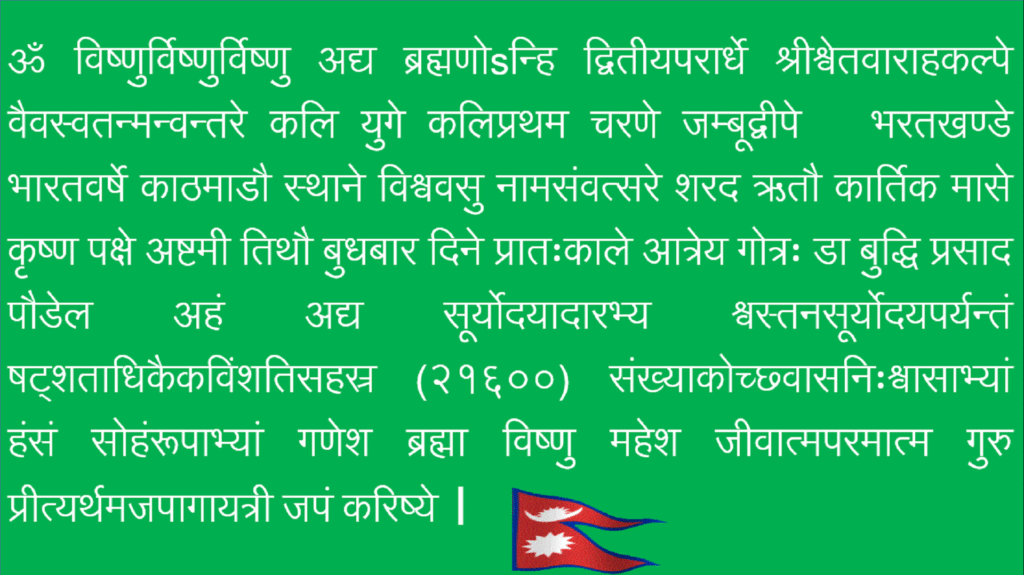
It is the spontaneous mantra repetition synchronized with the breath, most often through the sound “So…Ham” or “Ham…Sah”, symbolizing “I am That.”
According to yogic and Upanishadic teachings:
“Soham asmi” translates to “I am He (the Divine).”
Every inhalation naturally produces the sound “So,” and every exhalation “Ham.”
Thus, Aajapa Japa transforms the natural act of breathing into a sacred meditation, where awareness flows seamlessly with the breath – without the need for verbal chanting.
The Sanskrit word Japa means the repetition of a mantra or divine name. Ajapa Japa literally means “the unspoken repetition” – the effortless, natural remembrance of the Divine that continues automatically with every breath.
In Yoga and Tantra texts, it is said that the breath itself chants the mantra:
The inhalation carries the sound So,
The exhalation carries the sound Ham –
together forming Soham (“I am That”).
When awareness is steady and breathing rhythmic, this silent mantra flows continuously, even without deliberate effort. That is Aajapa Japa – meditation without meditating, prayer without words.
According to the Himalayan Institute and classical Yoga sources, this practice synchronizes mind, breath, and consciousness, establishing inner harmony. Modern researchers on meditative neuroscience describe similar states as “autonomic self-regulation” and “parasympathetic dominance,” leading to stress reduction and improved wellbeing.
Why Practice Aajapa Japa?
To Establish Awareness in Time and Space
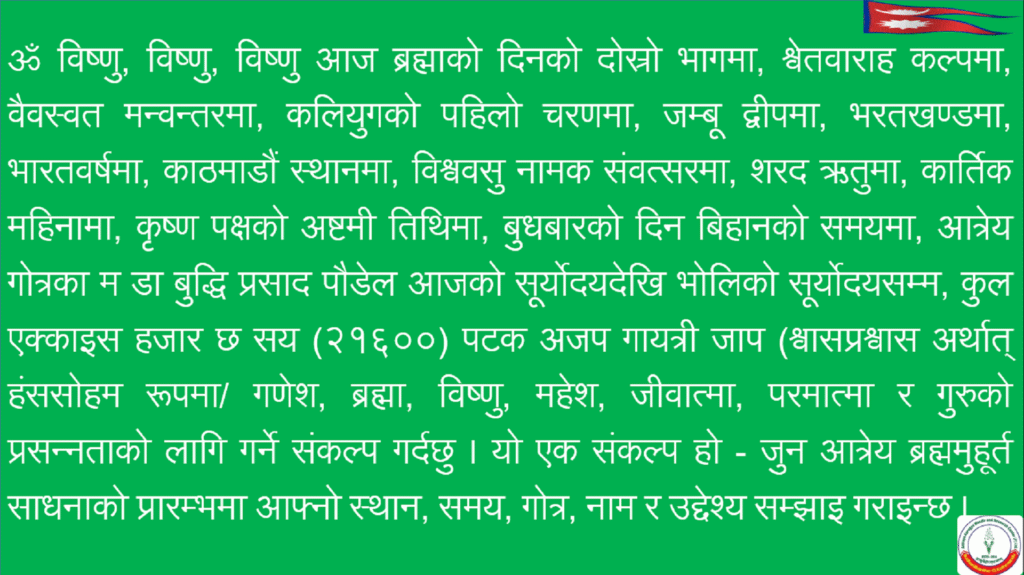
By stating one’s place, date, gotra, and identity at the beginning, the practitioner consciously acknowledges their existence in the vast web of time and space. It’s a ritual of awareness and grounding.
Every morning, as one utters the updated details — season, lunar date, weekday — one becomes present, alert, and connected to the cosmos.
To Unite Breath with Divinity
In most people, breathing is automatic and unconscious. Aajapa Japa transforms it into a sacred act. With every breath, the practitioner remembers that life itself is divine energy flowing through them. This transforms mechanical living into mindful living.
To Cultivate Physical Mental, and Spiritual Discipline
Daily Aajapa Japa cultivates rhythm, order, and self-control. It harmonizes the biological clock (circadian rhythm) with natural cycles of day and night, fostering the Ayurveda principle of Dinacharya – daily discipline for longevity and wellness.
How to Practice Ajapa Japa (Step-by-Step Guide)

Step 1: Preparation
Choose a peaceful place – your home temple, meditation corner, or a quiet garden.
Practice early in the morning (Brahma Muhurta – about 1.5 hours before sunrise).
Sit in a comfortable meditative posture – Padmasana, Sukhasana, or Vajrasana.
Step 2: Conscious Breathing
Gently close your eyes and observe your breath without controlling it.
Feel the natural rhythm of inhalation and exhalation.
Silently repeat the mantra “So-Ham” — So with inhalation, Ham with exhalation.
Allow the mind to merge with the flow of breath.
Step 3: Recite the Invocation
You may recite your version of the mantra with your own name, Gotra and location.
For example:
“In Kathmandu, during the autumn season, on the eighth lunar day of Kartika Krishna Paksha, I, Buddhi Prasad Paudel of Aatreya Gotra, begin my Aajapa Gayatri Japa from today’s sunrise until tomorrow’s sunrise, as an offering to the Divine.”
This personalization makes the practice dynamic – an updated awareness of the living moment.
Step 4: Enter the Aajapa Flow
After recitation, continue to observe the natural “So-Ham” rhythm of your breath.
At first, it may require effort – this is Japa.
With regular practice, it becomes effortless – this is Aajapa Japa, the continuous mantra of the soul.
Step 5: Closing
End the session with the offering:
“Hari Om Tat Sat, Sri Brahmarpanamastu” —
May this practice be an offering to the Supreme Reality.
Remain silent for a few moments before opening your eyes.
Physical, Mental and Spiritual Benefits
Effects on Physical Health
Scientific and traditional sources agree that Aajapa Japa enhances physiological harmony in many ways:
Improves respiration: Deep, rhythmic breathing expands lung capacity and optimizes oxygen intake.
Supports cardiovascular function: It activates the parasympathetic nervous system, stabilizing heart rate and lowering blood pressure.
Reduces stress hormones: Regular practice decreases cortisol levels, alleviating chronic stress and tension.
Boosts energy and immunity: By improving oxygen and nutrient delivery, it revitalizes cellular metabolism.
Enhances sleep quality: Calming the mind before sleep regulates circadian rhythm and deep rest.
Daily practice tips:
Start each morning with 5–10 minutes of Aajapa Japa in a quiet place.
Sit comfortably (Sukhasana or Vajrasana), spine straight.
Inhale softly with awareness of “So…”, exhale with “Ham…”.
Gradually increase duration as comfort grows.
This simple act can profoundly strengthen physical vitality and balance.
Physical Benefits
Enhances lung capacity and oxygen exchange through deep rhythmic breathing.
Balances the autonomic nervous system, reducing heart rate and blood pressure.
Improves sleep quality, digestion, and hormonal balance.
Supports immunity by lowering stress-induced inflammation.
Scientific research on meditative breathing (Harvard Medical School, 2018) confirms that rhythmic breath-based meditation activates the parasympathetic nervous system, lowering cortisol and improving immune resilience.
Effects on Mental Health
Aajapa Japa acts as a bridge between the body and mind, improving psychological wellbeing:
Reduces anxiety and depression: Focused breathing calms the nervous system, promoting mental clarity.
Improves concentration and memory: The continual focus on breath and mantra sharpens cognitive control.
Balances emotions: It cultivates emotional stability and resilience under stress.
Enhances mindfulness and self-awareness: By turning awareness inward, one learns to observe thoughts without reaction.
How to apply daily:
Take short “Aajapa breaks” between tasks – a few mindful breaths with Soham.
Before sleep, practice for 5 minutes to unwind and reset your nervous system.
During moments of anger, confusion, or sadness, return to your breath-mantra connection.
Mental Benefits
Reduces anxiety, depression and mental restlessness.
Improves focus, memory, and emotional stability.
Promotes mindfulness – being aware of each moment without judgment.
Develops self-awareness and emotional intelligence.
Aajapa Japa’s continuous awareness acts as a “neural reset,” helping the mind release unnecessary thought patterns and reestablish clarity.
Spiritual Benefits
Awakens higher consciousness by merging the individual breath with universal rhythm.
Fosters humility, gratitude, and a sense of divine companionship.
Leads toward Aatma-Bodha – realization of one’s true Self as a fragment of Brahman.
When practiced sincerely, the mantra “Soham” transforms into the experiential understanding:
“I am That – the Infinite Consciousness.”
Social and Behavioral Impact
A person who is physically and mentally balanced naturally contributes positively to society.
Develops discipline and consistency: Daily practice creates order and time-consciousness.
Improves relationships: Inner calm fosters patience and empathy in social interactions.
Creates positive presence: Practitioners radiate calm energy that inspires others.
Reduces workplace stress: Studies suggest mindful breathing enhances cooperation and performance.
Practical applications:
Conduct 5–10 minute group Aajapa sessions with family in the morning or evening.
Share your experience in your community to encourage mindfulness-based living.
Spiritual and Consciousness Benefits
Aajapa Japa is not merely a breathing exercise – it is a sacred path to transcendence:
Leads to self-realization: The mantra “Soham” (I am that) dissolves the illusion of separation between self and the Divine.
Dissolves ego and attachment: Continuous awareness weakens identification with body and mind.
Gateway to higher consciousness (Samadhi): Prolonged practice can elevate consciousness beyond duality.
Brings inner purpose and alignment: Regular meditation clarifies one’s dharma (true path).
Spiritual integration methods:
At the end of each day, reflect: “How peaceful and aware was I today?”
Keep a meditation journal.
Deepen understanding by studying scriptures like the Katha Upanishad and Yoga Vasistha that reference Aajapa Japa.
Aajapa Japa in Ayurveda and Yogic Science
In Ayurveda, Prana (life energy) is the vital force that sustains body and mind. Its proper flow maintains balance among the Tridosha – Vata, Pitta, and Kapha.
Aajapa Japa, by regulating breath and awareness, directly harmonizes Prana Vayu, the subtle air principle responsible for mental clarity, nervous system function, and spiritual awakening.
This aligns perfectly with Dinacharya (daily routine) and Sadvritta (ethical conduct):
Rising early in Brahma Muhurta,
Aligning the mind with the solar rhythm,
Cultivating truthfulness, self-discipline, and divine awareness.
In Yogic Psychology, Aajapa Japa represents Pranayama with mantra awareness. It activates Anahata (heart) and Aagya (third eye) chakras, harmonizing emotions and intuition.
Aajapa Japa and Modern Lifestyle
Today’s world is dominated by digital overload, multitasking and mental exhaustion. People suffer from chronic stress, hypertension, insomnia, and anxiety. Aajapa Japa offers a simple, natural solution:
Morning grounding practice – helps start the day with clarity and positivity.
Mid-day micro-practice (2–3 minutes) – reduces stress and restores focus.
Evening practice – transitions the mind toward calmness and restful sleep.
Unlike mechanical meditation apps or temporary relaxation techniques, Aajapa Japa cultivates living awareness – being fully present with your breath, wherever you are.
Social and Ethical Dimension
Regular Aajapa Japa creates disciplined, peaceful individuals – the foundation of a harmonious society. When practiced collectively in homes, schools, or workplaces, it fosters empathy, patience, and mindful communication.
Encouraging daily Aajapa Japa can thus become a social wellness movement, integrating spiritual mindfulness into education, healthcare, and governance – precisely aligning with Aatreya Ayurveda’s mission to promote preventive and promotive health through conscious living.
Precautions and Practical Advice
Begin gradually; start with 5–10 minutes daily and extend naturally.
Practice on an empty stomach, in a quiet place, at the same time every day.
If you have medical conditions (cardiac or psychiatric), consult a qualified Ayurveda physician or Yoga expert before deep breath-based practices.
Always end the session with gratitude and surrender – never with haste or distraction.
Aajapa Japa: An Ayurveda-Spiritual Lifestyle
Aajapa Japa is not limited to a meditation technique – it is a lifestyle discipline combining:
Mindful breathing (Pranayama),
Mantra awareness (Japa),
Divine offering (Samarpana),
Daily routine awareness (Dinacharya),
Moral refinement (Sadvritta).
It is the living expression of Ayurveda Yoga Integration – a synthesis of physical vitality, mental serenity, social harmony, and spiritual awakening.
Research Findings
Recent studies and experiential reports have validated many benefits of Aajapa Japa:
Reduces sympathetic nervous activation and increases parasympathetic dominance (calming response).
Enhances heart rate variability (HRV) – a marker of resilience and cardiac health.
Brain imaging studies show reduced activity in the Default Mode Network (DMN), promoting mindfulness.
Participants report improved sleep, emotional balance, and cognitive clarity with consistent practice.
(Source references: Shiv-Yogi 2025; Yogi Press; Big Shakti; Mantra Yoga Meditation Institute)
How to Build a Regular Aajapa Japa Habit
Set a fixed time and space – ideally at dawn and before bedtime.
Sit comfortably with a straight spine and relaxed shoulders.
Synchronize Breath and Mantra
Inhale → silently think “So…”
Exhale → silently think “Ham…”
Start small: Begin with 5 minutes, then increase gradually.
Track your progress: Note emotional, physical, or energetic shifts daily.
Practice with a group or family to maintain consistency.
Seek guidance from experienced teachers or Ayurveda healers if needed.
Avoid overexertion – balance and moderation are key.
Maintain patience: Transformation unfolds subtly with time and sincerity.
Conclusion
Aajapa Japa is a simple yet profound practice that unites body, mind, and spirit through breath awareness and inner mantra.
Incorporating it into daily life helps reduce disease, anxiety, and emotional unrest while nurturing harmony and spiritual growth.
When practiced sincerely, Aajapa Japa becomes a living prayer, transforming each breath into meditation and each moment into divine awareness.
Let this timeless discipline guide you toward health, peace, and liberation.
Om Shanti! Shanti! Shanti! – May there be peace in body, mind and soul.
Aajapa Japa Mantra Aajapa Japa Mantra Aajapa Japa Mantra Aajapa Japa Mantra Aajapa Japa Mantra Aajapa Japa Mantra Aajapa Japa Mantra Aajapa Japa Mantra Aajapa Japa Mantra Aajapa Japa Mantra Aajapa Japa Mantra Aajapa Japa Mantra Aajapa Japa Mantra Aajapa Japa Mantra Aajapa Japa Mantra Aajapa Japa Mantra Aajapa Japa Mantra Aajapa Japa Mantra Aajapa Japa Mantra Aajapa Japa Mantra Aajapa Japa Mantra Aajapa Japa Mantra Aajapa Japa Mantra Aajapa Japa Mantra