

Brahmavihara


Table of Contents
Brahmavihara (ब्रहमविहार) literally means “the dwellings of the Brahma—the highest, purest states of mind.”
These four mental qualities create a foundation for emotional balance, spiritual awakening, and compassionate living.
The term appears widely in:
Pāli Canon (Nikāya literature)
Abhidhamma Pitaka
Visuddhimagga (Buddhaghosa’s Commentary)
Dhammapada
Yoga and Ayurveda literature as parallel concepts like Maitri, Karuṇa, Mudita, Upeksha (Yoga Sutra 1.33)
Etymology and Meaning
Brahma + Vihara
Brahma = noble, sublime, divine
Vihara = dwelling, abiding, way of living
Thus, Brahmavihara means:
“Abiding in divine qualities.”
“Dwelling with a pure and limitless heart.”
The Buddha taught these qualities as limitless meditative states (appamañña) leading to liberation.
Classical Source:
Dīgha Nikāya 13 (Tevijja Sutta)
Majjhima Nikāya 7, 40, 99
Aṅguttara Nikāya 4.125, 4.126
The Four Brahmaviharas with Scriptural References
Maitri (मैत्री / Loving-kindness)
Meaning
Unconditional goodwill toward all beings.
Desire for all to be happy, peaceful, and safe.
Scriptural Reference
Metta Sutta (Sn 1.8, Khp 9)
“Sukhino vā khemino hontu sabbe sattā”—May all beings be happy and secure.
Dīgha Nikāya 13:
Mettā is the path to Brahma-world.
Benefits (Classical)
“Sleeps well, wakes well and dreams no evil.” (AN 11.16)
Develops a radiant mind (pabhassara citta)
Eliminates anger, hatred, and fear.
Karuna (करुणा / Compassion)
Meaning
The heartfelt wish to help those who suffer.
It is an active, empathetic response to pain.
Scriptural Reference
Majjhima Nikāya 7:
A monk suffuses the world with compassion in all directions.
Visuddhimagga IX:
Describes Karuṇā as the antidote to cruelty.
Benefits
Softens the heart
Prevents harmful actions
Develops moral courage and empathy
Mudita (मुदिता / Sympathetic or Appreciative Joy)
Meaning
Rejoicing in the success, good fortune, and happiness of others.
Scriptural Reference
Aṅguttara Nikāya 3.65:
Encourages Mudita for breaking envy (issā).
In Abhidhamma, Mudita is a wholesome mental factor increasing joy and virtue.
Benefits
Removes jealousy and comparison
Creates harmonious relationships
Strengthens community and cooperation
Upekkhā (उपेक्षा / Equanimity)
Meaning
Balanced, steady, even-minded awareness in all situations.
Not indifference—but wisdom-based stability.
Scriptural Reference
Majjhima Nikāya 137:
Describes Upekkhā as the “highest refinement of the mind.”
Dhammapada 81:
“Just as a solid rock is unmoved by wind, so is the wise unshaken by praise or blame.”
Benefits
Neutralizes attachment and aversion
Develops wisdom and clarity
Supports deep meditation (Dhyana)
Brahmavihara in Yoga Philosophy
Patanjali Yoga Sutra 1.33 explicitly parallels the four Brahmavihara:
Maitri (friendliness), Karuṇa (compassion), Mudita (joy), Upekṣa (equanimity)
as methods to purify the mind (citta-prasādana).
This shows cross-cultural integration between Buddhist meditation and Yoga–Ayurveda psychology.
How Brahmavihara Transform Mental and Emotional Health
Modern psychology aligns Brahmavihara with:
Positive Psychology (well-being, resilience)
Mindfulness-based therapy
Compassion-focused therapy
Emotional regulation models
Benefits Include:
Stress reduction
Reduced anxiety & anger
Improved emotional intelligence
Enhanced relationships
Spiritual growth
In Ayurveda, these qualities support Sattva Guna, balancing the mind and promoting longevity (Ayushya).
Practical Daily Practice of Brahmavihara
Mettā Meditation Formula
“May I be happy, may I be peaceful and may I be free from suffering.”
Then extend to:
Family
Neutral people
Difficult people
All beings
Karuna Practice
Witness suffering → Allow empathy → Wish to help → Act wisely.
Mudita Practice
Celebrate others’ success consciously.
Say mentally:
“May your happiness continue and grow.”
Upekkhā Practice
Observe without reaction.
Remember:
“Everything is impermanent. Balance is wisdom.”
The Ultimate Goal of Brahmavihara
According to Tevijja Sutta (DN 13):
Practicing Brahmavihara leads to
Brahmaloka (the highest heavenly realm)
and acts as a foundation for
Nirvana / Moksha.
They are both:
A path of compassion
A path of liberation
Types of “विहार (Vihara)” in Different Scriptures
(With Classical References)
The Sanskrit/Pāli word Vihara (विहार / विहार) has multiple meanings:
Living
Moving
Behaving
Dwelling
Abiding
Enjoying
Wandering
Cultivating a mental state
Depending on the scripture, “Vihara” may refer to:
Physical dwellings (monasteries)
Behavioral practices
Mental states
Meditative abodes
Below is the complete classification.
Buddhist Scriptures: Four Types of Vihara (Mental Abodes)

(Most classical and widely used doctrine of Vihara)
In Buddhist Pali Canon, Vihara = dwelling of the mind, therefore 4 Brahmavihara:
Mettā Vihara (मेत्ता विहार)
Dwelling in loving-kindness.
Source: Dīgha Nikāya 13, Majjhima Nikāya 7, Aṅguttara Nikāya 4.125
Karuṇā Vihara (करुणा विहार)
Dwelling in compassion.
Source: MN 7, AN 4.125
Muditā Vihara (मुदिता विहार)
Dwelling in appreciative joy.
Source: MN 99, AN 3.65
Upekkhā Vihara (उपेक्षा विहार)
Dwelling in equanimity.
Source: MN 137, DN 13
These are called BrahmaViharas because they resemble the pure and divine mental states of Brahma.
Buddhist Monastic Classification: Physical Viharas (Dwelling Places)
In Vinaya Pitaka and Dhammapada, the word Vihara also refers to monasteries.
Five types of physical Viharas (Vinaya Cullavagga VI.1)
Vihara – A permanent dwelling
Addhayoga – Retreat hut
Pāsāda – Mansion-like monastery
Hammiyā – Roofed shelter
Guhā – Cave retreat
These are rules for monks regarding their living places.
Yoga Scriptures (Patanjali Yoga Sutra 1.33)
Here, “Vihara” is not used explicitly, but the four attitudes correspond exactly to BrahmaVihara:
Maitrī (Friendliness)
Karuṇā (Compassion)
Muditā (Joy at others’ success)
Upekṣā (Equanimity)
These are considered “Chitta-prasādana upāya”—states that purify the mind.
In Yoga, Vihara = mind’s dwelling attitude.
Vedic and Puranic Literature: Vihara as Conduct & Lifestyle
The word विहार appears in various contexts in Vedas, Upanishads and Itihasas – Purana, primarily meaning:
Living, moving, wandering (गमन)
Enjoyment (क्रीडा, रमण)
Conduct / behavioral pattern (आचार)
Types of Vihara in Classical Sanskrit Literature
As per Amarakosha and Panini:
चेष्टा-विहार – physical movement
क्रीडा-विहार – play, recreation
गमन-विहार – wandering, travelling
रमण-विहार – enjoyment
आचार-विहार – conduct or behavior
निवास-विहार – dwelling place
मानस-विहार – mental dwelling / meditation
These definitions prepared the linguistic foundation for Buddhist usage.
Ayurveda Literature: Health-Related “Vihara”
In Ayurveda, the word विहार is central and refers to lifestyle activities.
Two Types of Vihara in Ayurveda
Shareerika Vihara (शारीरिक विहार)
Physical activities & lifestyle
Vyayama (exercise)
Snana (bathing)
Shayana (sleep)
Bhojana Vihara (eating behavior)
Manasika Vihara (मानसिक विहार)
Mental-emotional lifestyle
Sattvik behavior
Avoiding anger, jealousy, greed
Meditation
Charaka Samhita References:
Dinacharya Adhyaya (Sutra Sthana 5)
Sadvritta (Sutra Sthana 8)
Achara Rasayana (Ch. 1, Sutra 30)
Here, “Vihara” = healthy lifestyle and daily routine.
Jain Scriptures: Three Types of Vihara
In Jain Agamas and commentaries:
Sharira Vihara (शरीर विहार) – physical movement
Bhāva Vihara (भाव विहार) – purity of emotions
Adhyatma Vihara (अध्यात्म विहार) – spiritual contemplation
Jainism emphasizes Vihara as non-violent movement and mindful behavior.
Tantric & Buddhist Vajrayana Texts
In Tibetan Buddhism, Vihara = pure realms / peaceful abiding states.
There are three levels:
Samatha Vihara – calm-abiding
Vipassana Vihara – insight dwelling
Mahasukha Vihara – blissful abiding
These are meditative states leading to realization.
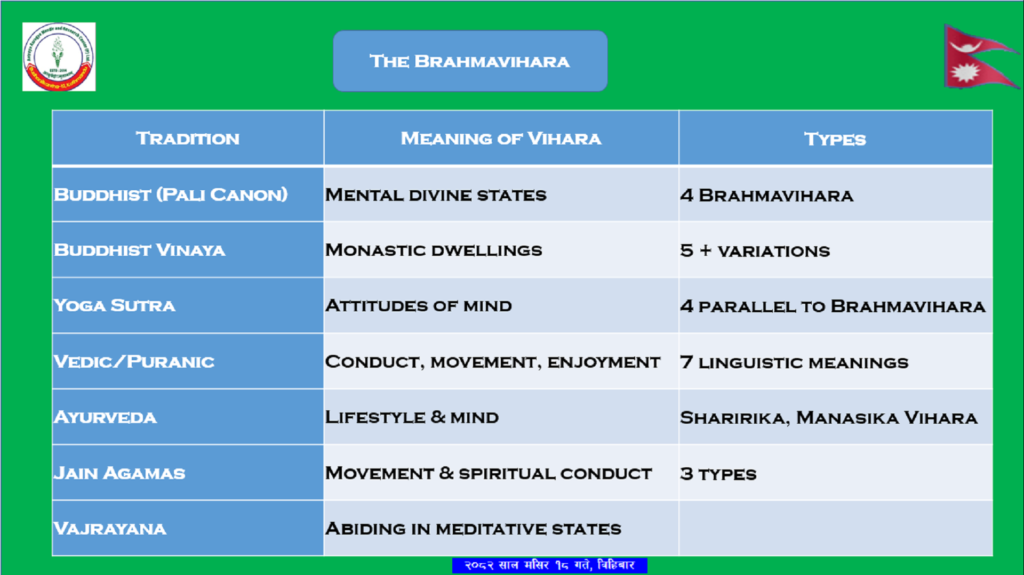
Summary Table: Types of Vihara across Scriptures
Conclusion
Brahmavihara is not just a meditation technique-it is a complete lifestyle philosophy for mental purity, emotional maturity, and universal love. Rooted in ancient scriptures, these four qualities-Mettā, Karuṇā, Muditā, Upekkhā—offer a timeless guide for inner peace and global harmony.


