
Mental Illness and Ayurveda
Table of Contents
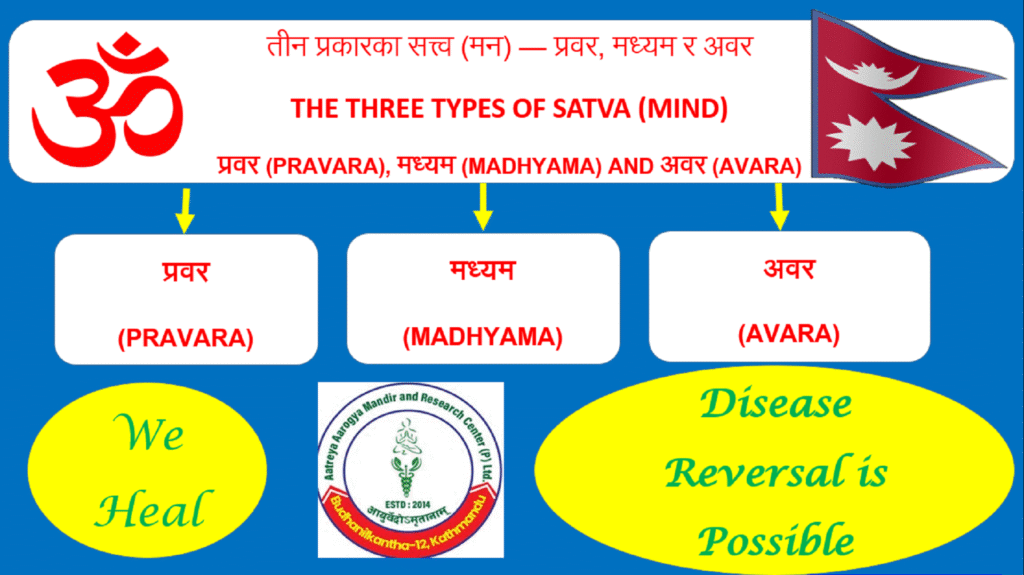
The Three Types of Mind – Pravara, Madhyama, and Avara Sattva
(An Ayurveda Perspective with Modern Psychological Correlation)
Introduction
Ayurveda and the Sankhya philosophy consider Manas (mind) not merely as a functional entity of perception and cognition, but as a determinant of both health and disease. The three gradations of Sattva – Pravara (superior), Madhyama (moderate), and Avara (inferior) — describe the quality, purity, and stability of the mind. These gradations influence emotional resilience, decision-making, moral tendencies, and vulnerability to mental disorders.
This article discusses the Ayurveda interpretation of these three types of minds, their behavioral expressions, correlations with modern psychological models, and implications for mental health management.
Ayurveda Basis – The Concept of Sattva
In Ayurveda, the mind is governed by three Guna – Sattva (clarity and harmony), Rajas (activity and passion), and Tamas (inertia and ignorance).
Among these, Sattva represents purity, stability, and insight.
According to Charaka Samhita (Vimanasthana 8/119), individuals differ in Sattva-Bala (mental strength), and based on this, are classified as:
Pravara Sattva – Highly stable, pure, and self-controlled mind.
Madhyama Sattva – Moderately stable and balanced mind.
Avara Sattva – Weak, impure, and unstable mind.
This classification provides a foundation for understanding mental constitution (Manas Prakriti).
Description, Features, and Modern Psychological Correlates
Pravara Sattva (Superior Mind)
Ayurveda Features:
Pure, steady, fearless, intelligent, and virtuous.
Excellent memory, self-control, and discriminative power (Viveka).
Unaffected by sorrow, anger, greed, or fear.
Inclined toward meditation, knowledge, and compassion.
Behavioral Expression:
Handles stress gracefully, maintains composure in adversity, and acts ethically.
Strong sense of purpose and emotional maturity.
Modern Correlation:
High emotional intelligence, psychological resilience, and secure personality.
Stable mood regulation; similar to self-actualized personality in humanistic psychology.
Possible Mental Health Issues (if any):
Rare, but burnout or perfectionism may occur due to excessive idealism or responsibility.
Madhyama Sattva (Moderate Mind)
Ayurveda Features:
Balanced intellect and emotion, but affected by moderate stress.
Can reason well but sometimes influenced by desire, fear, or social pressure.
Fluctuating but functional mental equilibrium.
Behavioral Expression:
Reflects the average human tendency – balanced yet sometimes reactive to challenges.
Capable of introspection but requires external motivation.
Modern Correlation:
Corresponds to individuals with moderate resilience and adaptive coping.
Vulnerable to situational anxiety or mild depression under stress.
Possible Mental Health Issues:
Mild to moderate anxiety, reactive depression, stress-induced insomnia, adjustment disorders.
Usually reversible with counseling, lifestyle modification, and support.
Avara Sattva (Inferior Mind)
Ayurveda Features:
Lacks clarity and judgment; dominated by fear, anger, greed, or attachment.
Low self-confidence, poor impulse control, and irrational behavior.
Emotionally unstable and easily disturbed.
Behavioral Expression:
Tends toward pessimism, dependency, and social withdrawal.
Difficulty in maintaining relationships and professional stability.
Modern Correlation:
Low emotional resilience, high neuroticism, poor stress tolerance.
Predisposition to mental disorders such as depression, anxiety, addiction, or psychosis.
Possible Mental Health Issues:
Major depressive disorder, generalized anxiety disorder, substance use disorders, or psychotic spectrum disorders (when combined with genetic/environmental risk factors).
Note: Low Sattva is not a diagnosis but a risk factor for vulnerability. Genetics, environment, and social factors remain equally important.
Distinguishing Signs in Daily Life

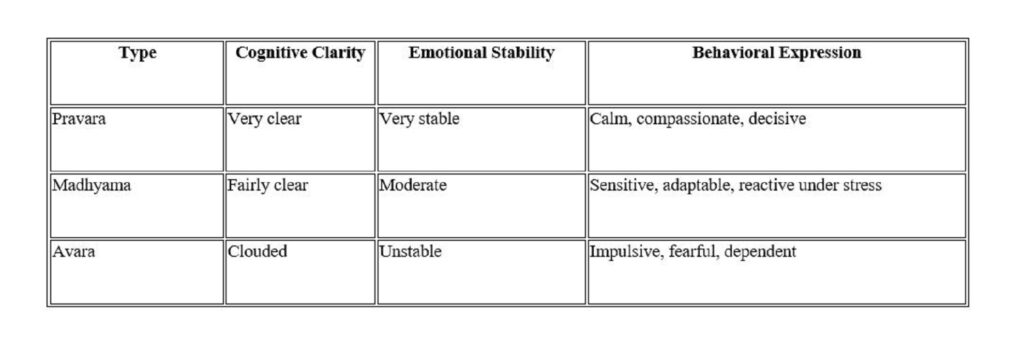
Screening tools such as Resilience Scale, PHQ-9 (Depression), and GAD-7 (Anxiety) can help identify the current state, though Ayurveda assessment involves lifestyle, habits, and thought patterns.
Causes and Risk Factors
Ayurveda Causes:
Irregular diet (Aahara), poor routine (Dinacharya), and indulgence in unwholesome activities (Pragyaparadha).
Excessive sensory stimulation, lack of rest, or neglect of spiritual practices.
Emotional trauma or hereditary tendencies.
Modern Causes:
Genetic predisposition, neurotransmitter imbalance, chronic stress, social isolation, and adverse childhood experiences.
Ayurveda Tridosha–Mind Connection:
Vata imbalance → anxiety, restlessness.
Pitta imbalance → irritability, anger.
Kapha imbalance → lethargy, depression.
Assessment and Screening
Ayurveda assessment through lifestyle history, sleep, diet, moral habits, and stress-handling pattern.
Modern psychometric tests (PHQ-9, GAD-7, Resilience scales).
Referral to psychiatrist if suicidal ideation, hallucination, or severe functional impairment is noticed.
Management and Therapeutic Approach
(Integrative – Ayurveda + Modern Psychology)
Ayurveda Approaches
Satvavajaya Chikitsa (Psychotherapy)
Restraining the mind from unwholesome objects; cultivating positive thoughts, awareness, and detachment.
Sattvik Diet:
Light, fresh, pure, easily digestible foods – avoid alcohol, stale, spicy, and excessively hot or cold foods.
Daily Regimen (Dinacharya):
Early rising, meditation, self-reflection, and balance between activity and rest.
Rasayana Therapy:
Herbs that rejuvenate mind and intellect – Brahmi, Shankhpushpi, Ashwagandha, Shatavari (under guidance).
Panchakarma & Abhyanga:
Detoxification therapies and oil massage to balance doshas and calm the nervous system.
Aatreya Ayurveda Clinical Panchakarma with Marma Therapy, Sarvanga Svedana .
Aatreya Ayurveda Spiritual Psychosocial Counselling
Modern Psychiatric Approaches
Psychotherapy: Cognitive Behavioral Therapy (CBT), Mindfulness-Based Therapy, Acceptance and Commitment Therapy (ACT).
Medication (if needed): Antidepressants, anxiolytics, or antipsychotics under psychiatric supervision.
Mindfulness & Meditation: Enhances Sattva and reduces stress reactivity.
Lifestyle Interventions: Regular sleep, exercise, social connection, purpose-oriented work.
Integrative Model
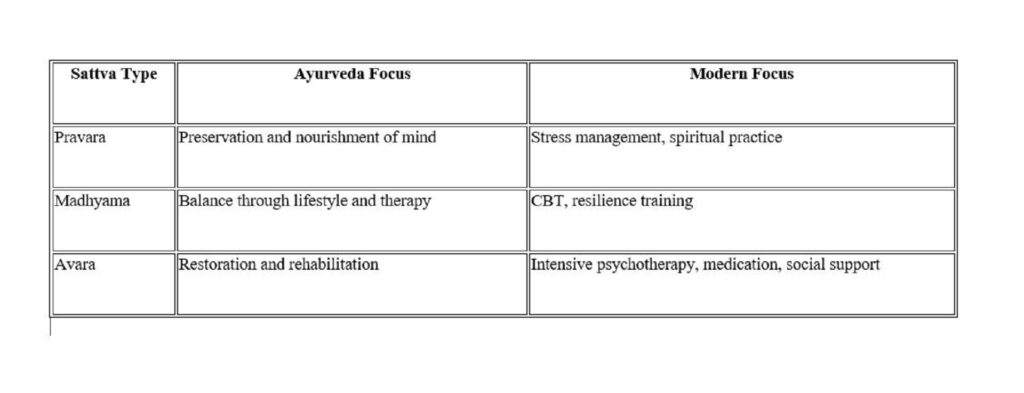
Preventive Strategies
Education: Mental health literacy based on Ayurveda psychology in schools and communities.
Lifestyle: Regular routine, Sattvik diet, adequate sleep, moderation in sensory indulgence.
Meditation and Yoga: Daily 20–30 minutes for emotional regulation and neural stability.
Social Connection: Strong family and community relationships reduce vulnerability.
Early Screening: Identify risk groups – those under chronic stress or substance use – and intervene early.
Illustrative Case Examples
Pravara Sattva:
A 45-year-old social worker develops work burnout. Managed through rest, yoga, and reduced workload – full recovery.
Madhyama Sattva:
A 28-year-old woman faces anxiety after relationship conflict. Improved with CBT, mindfulness, and mild Rasayana therapy.
Avara Sattva:
A 35-year-old man with chronic stress and alcohol dependency. Recovered through integrative approach – detoxification, psychotherapy, Rasayana, and family counseling.
Public Health and Policy Perspective
Integrate Ayurveda mental health principles into primary care programs.
Promote community-based Sattva enhancement programs: yoga, meditation, ethical education, and stress awareness.
Train healthcare workers in early recognition of mind – body imbalances.
Mental Health and Hormones: A Comprehensive Overview
Hormones play a crucial role in regulating mood, emotions, cognition, and overall mental health. They act as chemical messengers between the brain and body, influencing how we think, feel, and behave. An imbalance in these hormones can lead to anxiety, depression, mood swings, fatigue, and other psychological disorders.
Key Hormones Influencing Mental Health
Serotonin – The “Happiness Hormone”
Produced in: Brain and gut (mainly in the intestines)
Functions:
Regulates mood, sleep, appetite, and digestion
Promotes feelings of well-being and emotional stability
Low levels lead to: Depression, anxiety, insomnia, irritability
Ayurveda correlation: Balanced Sattva Guna and proper Agni help maintain optimal serotonin levels.
Dopamine – The “Motivation and Reward Hormone”
Produced in: Substantia nigra and ventral tegmental area of the brain
Functions:
Controls pleasure, motivation, and learning
Enhances focus and goal-directed behavior
Low levels lead to: Low motivation, addiction tendency, fatigue, lack of pleasure (Anhedonia)
Excess levels: Mania, impulsivity, psychosis
Ayurveda correlation: Linked with Rajas Guna and Tejas energy; balanced by meditation and Sattvik Aahara.
Cortisol – The “Stress Hormone”
Produced in: Adrenal glands
Functions:
Helps manage stress and regulate energy
Influences metabolism and immune function
Chronic elevation leads to: Anxiety, depression, insomnia, weight gain, memory problems
Low levels cause: Fatigue, low motivation, brain fog
Ayurveda correlation: Related to Vata-Pitta imbalance; managed by Abhyanga, Brahmamuhurta Sadhana, and Pranayama.
Oxytocin – The “Love and Bonding Hormone”
Produced in: Hypothalamus, released by the posterior pituitary
Functions:
Promotes trust, bonding, empathy, and social connection
Reduces stress and anxiety
Low levels lead to: Loneliness, emotional detachment, postpartum depression
Enhanced by: Touch, compassion, meditation, and chanting
Ayurveda correlation: Promotes Sattva Guna and Hridaya (emotional center) balance.
Endorphins – The “Natural Painkillers”
Produced in: Pituitary gland and central nervous system
Functions:
Relieve pain, enhance pleasure and reduce stress
Low levels cause: Sadness, pain sensitivity, low resilience
Boosted by: Exercise, laughter, sunlight, and positive activities (Sattvik Kriya)
Estrogen and Progesterone – The “Mood Modulators”
Produced in: Ovaries (females), small amount in adrenal glands (males)
Functions:
Regulate mood, sleep, and cognition
Balance serotonin and GABA activity
Imbalance leads to: PMS, Premenopausal mood swings, anxiety, irritability
Ayurveda correlation: Governed by Kapha and Pitta doshas; Shatavari, Ashoka, Kumari balance female hormones.
Testosterone – The “Confidence Hormone”
Produced in: Testes (males), ovaries (females), adrenal glands
Functions:
Influences mood, energy, motivation, and confidence
Low levels cause: Depression, fatigue, loss of drive
Ayurveda correlation: Linked with Ojas and Virya Bala; enhanced by Rasayana Chikitsa and Brahmacharya.
Mind–Body Connection: Ayurveda Perspective
According to Ayurveda, mental health (Manasika Svasthya) depends on the balance of three Guna:
Sattva – purity, clarity and harmony → leads to peace and happiness
Rajas – activity, passion and restlessness → leads to anxiety or hyperactivity
Tamas – inertia, ignorance and darkness → leads to depression or lethargy
Balanced hormones support Sattva Guna, while imbalance increases Rajas and Tamas leading to psychological disturbances.
Ayurveda Approaches to Balance Mental Health Hormones
Brahmamuhurta Sadhana – enhances serotonin and dopamine balance
Meditation & Pranayama – reduces cortisol, boosts endorphins and oxytocin
Dinacharya (Daily routine) – stabilizes circadian rhythm, balancing hormone secretion
Sattvik Diet – promotes mental clarity (includes milk, ghee, fruits, nuts, grains)
Rasayana Therapy – Brahmi, Ashwagandha, Shankhapushpi, Mandukaparni enhance neurotransmission
Sound and Mantra Therapy – stimulates pineal gland, melatonin, and parasympathetic tone
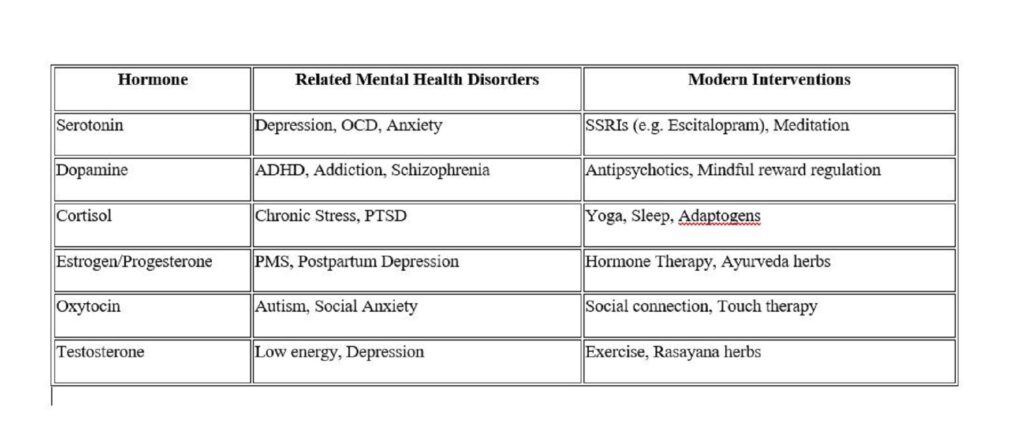
Modern Clinical Correlation
Conclusion
The Ayurveda classification of Pravara, Madhyama, and Avara Sattva offers a timeless framework to understand human psychology and emotional strength. When correlated with modern psychiatry, it bridges traditional wisdom with evidence-based care.
A low Sattva state does not imply disease but indicates vulnerability – which can be corrected through proper diet, discipline, counseling, and spiritual awareness.
An integrative approach combining Ayurveda, modern psychotherapy, and lifestyle modification ensures the highest level of mental well-being and emotional balance.
Mental health is not merely a brain-centered phenomenon but a neuroendocrine harmony of hormones, mind, and consciousness. Ayurveda recognizes this interplay centuries before modern endocrinology – focusing on Sattva promotion, daily discipline, and natural living to balance these subtle bio-chemicals for enduring mental wellness.
Mental Illness and Ayurveda Mental Illness and Ayurveda Mental Illness and Ayurveda Mental Illness and Ayurveda Mental Illness and Ayurveda Mental Illness and Ayurveda Mental Illness and Ayurveda Mental Illness and Ayurveda Mental Illness and Ayurveda Mental Illness and Ayurveda Mental Illness and Ayurveda Mental Illness and Ayurveda Mental Illness and Ayurveda Mental Illness and Ayurveda Mental Illness and Ayurveda Mental Illness and Ayurveda Mental Illness and Ayurveda Mental Illness and Ayurveda Mental Illness and Ayurveda

