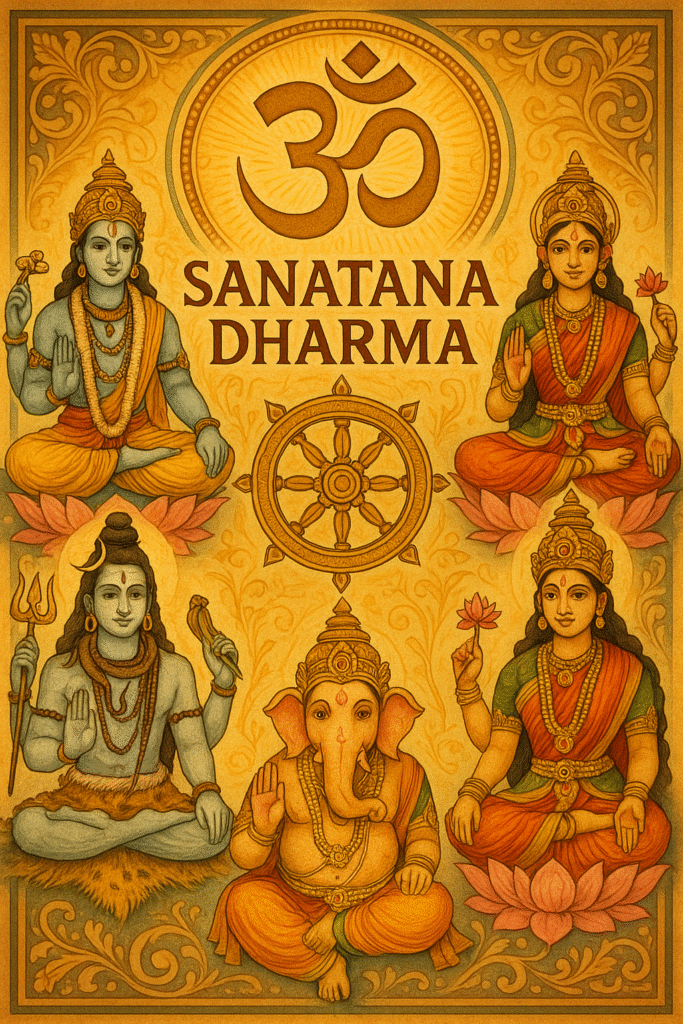


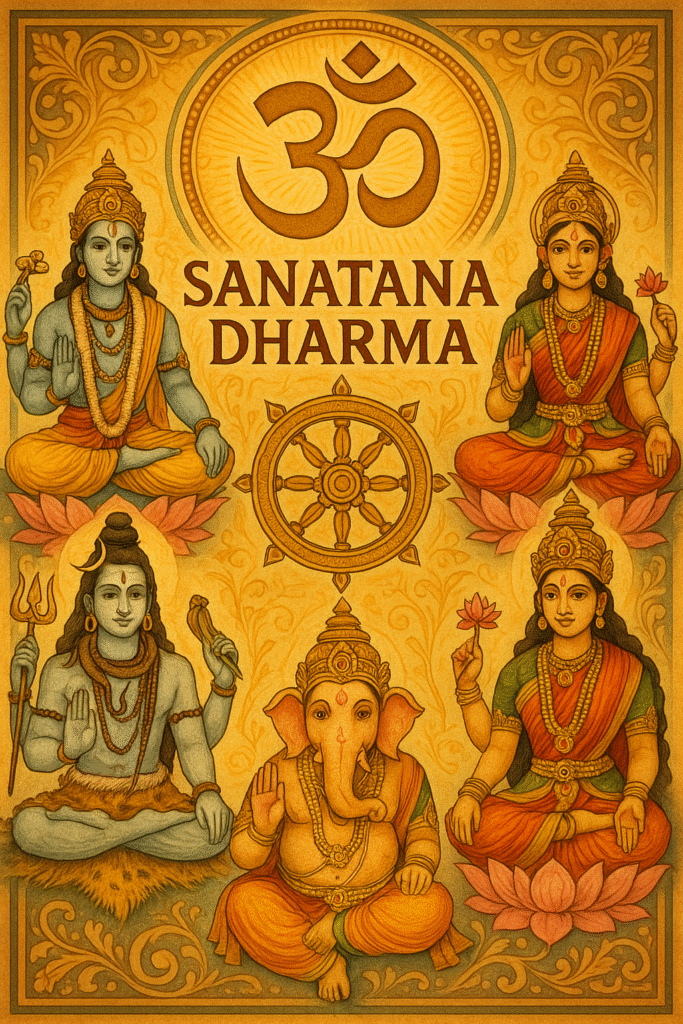
Sanatana Dharma: A Comprehensive Overview
Introduction
The term Sanatana Dharma is derived from Sanskrit, where Sanatana means “eternal,” “timeless,” or “everlasting,” and Dharma refers to “righteousness,” “cosmic law,” “duty,” or the “principle that upholds the universe.” Therefore, Sanatana Dharma means “the eternal and universal way of life.” It is not a religion founded by any individual, prophet, or institution; rather, it is a timeless spiritual and philosophical tradition rooted in the natural and cosmic order, developed through the direct realizations and insights of ancient sages (ṛishis).
Historical Background
Sanatana Dharma is considered the oldest living spiritual tradition in the world, with its roots in the Vedas, the ancient scriptures of the Indian subcontinent. The four Vedas — Rigveda, Yajurveda, Samaveda, and Atharvaveda — are vast repositories of knowledge covering cosmology, philosophy, rituals, ethics, medicine, music, and more.
The foundational texts of Sanatana Dharma include:
Upanishads (spiritual wisdom)
Mahabharata and Ramayana (epic narratives)
Smritis (codes of ethics and law)
Puranas (mythology and cosmology)
Ayurveda, Yoga Shastras, Jyotisha (Vedic astrology), and Natyashastra (performing arts)
Over time, Sanatana Dharma came to be commonly known as Hinduism, especially after foreign invasions and colonial misclassifications. However, Hinduism is actually a later term; Sanatana Dharma remains the original designation.
Philosophical Dimensions
Sanatana Dharma presents a deep and pluralistic philosophical system. It does not impose dogmas but encourages inquiry, realization, and harmony. The six classical systems of philosophy (Shad-Darshanas) are:
Nyaya – Logic and epistemology
Vaisheshika – Atomic theory and metaphysics
Sankhya – Dualism between Purusha (consciousness) and Prakriti (matter)
Yoga – Practical method for spiritual realization
Purva Mimamsa – Rituals and Vedic duties
Uttara Mimamsa (Vedanta) – Non-dualistic or theistic philosophy of Brahman
These philosophies explore the nature of reality, consciousness, the soul (Atman), and the Absolute (Brahman), ultimately guiding one toward Moksha (liberation).
Spiritual and Religious Practices
Sanatana Dharma encompasses diverse spiritual paths, allowing individuals to choose according to their temperament:
Karma Yoga – Path of selfless action
Bhakti Yoga – Path of devotion and love for the Divine
Jnana Yoga – Path of knowledge and self-inquiry
Raja Yoga – Path of meditation and discipline
Hatha Yoga – Path of physical purification and energy control
Foundational ethical principles include:
Yamas (restraints): Ahimsa (non-violence), Satya (truthfulness), Asteya (non-stealing), Brahmacharya (moderation), Aparigraha (non-possessiveness)
Niyamas (observances): Shaucha (cleanliness), Santosha (contentment), Tapas (discipline), Svadhyaya (self-study), Ishvarapranidhana (surrender to God)
Worship practices may include mantra chanting, meditation, puja (ritual), yajnas (sacrifices), pilgrimage, and festivals, all meant to align the individual with cosmic order.
Social Structure
Sanatana Dharma proposes a Varna-Ashrama Dharma model of society:
Varnas (Classes): Based on qualities and duties, not birth
Brahmana (knowledge and teaching)
Kshatriya (protection and governance)
Vaishya (commerce and agriculture)
Shudra (service and craftsmanship)
Ashramas (Life stages)
Brahmacharya (student life)
Grihastha (householder life)
Vanaprastha (retired life)
Sannyasa (renounced life)
These structures aim to guide individual and social development, emphasizing duty (Dharma) over rights or privileges.
Samskara and Culture
There are 16 Samskaras (life sacraments) from conception to death that mark the spiritual evolution of an individual. These include:
Garbhadhana (conception),
Namakarana (naming ceremony),
Upanayana (initiation into education),
Vivaha (marriage),
Antyeshti (last rites), etc.
Sanatana Dharma also encompasses:
Music (Sangeet), Dance (Nritya), Architecture (Vastu), Fine Arts, and Drama (Natyashastra)
Festivals like Diwali, Holi, Navaratri, etc., which harmonize cosmic rhythms with human life
The aim is to elevate daily life into spiritual experience.
Scientific Aspects
Sanatana Dharma integrates spirituality with science and natural laws:
Ayurveda – Holistic science of health and longevity
Yoga – Mind-body discipline leading to mental clarity and transcendence
Jyotisha (Vedic astrology) – Study of cosmic influence on life
Vastu Shastra – Principles of harmonious dwelling
Mathematics, Astronomy, Metallurgy, Ecology – All embedded in ancient texts
Many of these principles are being rediscovered and validated by modern science today.
Contemporary Relevance
In the current era of environmental degradation, psychological stress, and moral crisis, Sanatana Dharma offers a universal, sustainable, and spiritual way of living. Its principles — Ahimsa (non-violence), Satya (truth), Dharma (righteousness), Shanti (peace), Daya (compassion), and Vasudhaiva Kutumbakam (the world is one family) — are urgently needed.
It is not a sectarian religion but a cosmic vision of unity in diversity, making it highly relevant across cultures and times.
Conclusion
Sanatana Dharma is not merely a religion; it is an eternal system of truth, discipline, and harmony with the cosmos. It is a path to individual liberation and collective welfare. Its inclusive nature accommodates atheists, theists, mystics, scholars, and seekers alike. At its heart lies the quest for truth (Satya), consciousness (Chit), and bliss (Ananda).
It teaches:
“Dharma protects those who protect it.” (Dharmo rakṣati rakṣitaḥ)
“Let noble thoughts come to us from all directions.” (Rigveda 1.89.1)