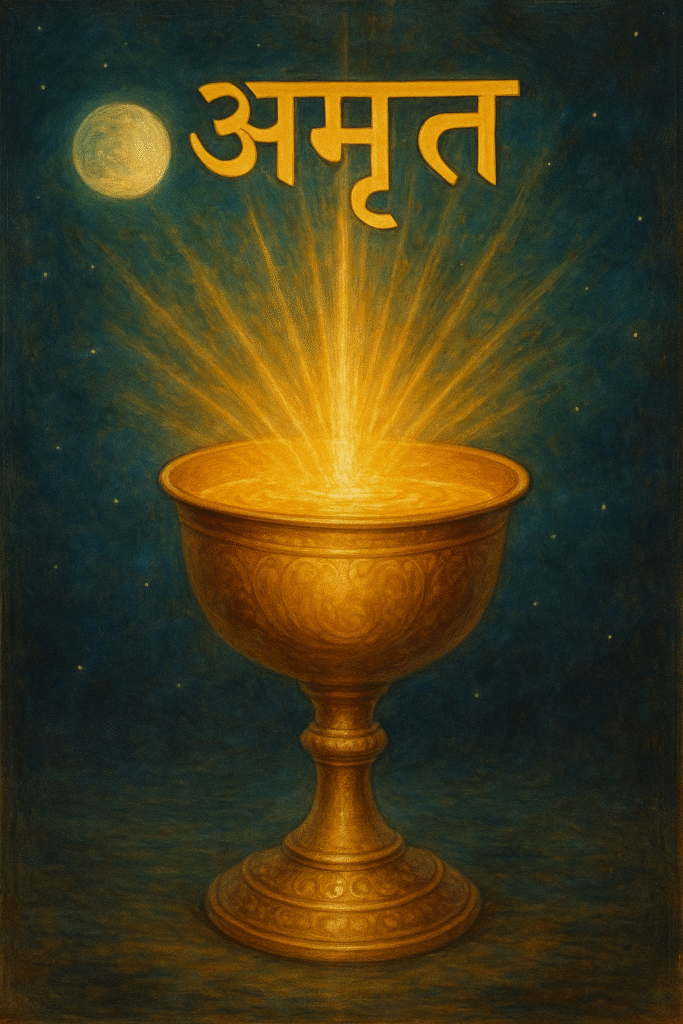

Amrita and Ayurveda: A Comprehensive Exploration from Veda, Ayurveda and Spiritual Perspectives
Amrita and Ayurveda: An Introduction
The Sanskrit term “Amrita” literally translates to “immortality” — a (not) + mrita (death), meaning “that which does not die.” In Indic thought, it holds a central place across Vedic hymns, Puranic lore, Ayurveda, Yoga, and Bhakti traditions. It is not merely a mystical elixir but a symbol of eternal life, divine consciousness, supreme health, and liberation from suffering.
Vedic Perspective
In the Rigveda, Atharvaveda, and other Vedas, Amrita appears as:
The Soma juice — consumed by the gods to gain immortality.
A divine essence flowing from Agni (fire), Surya (sun), Vayu (air), and Varuna (cosmic order).
The Vedas describe Amrita as cosmic nectar, the very energy that sustains existence and consciousness.
Puranic Perspective
According to the Samudra Manthan (Churning of the Ocean) episode:
Both Devas (gods) and Asuras (demons) churned the ocean to obtain Amrita, the nectar of immortality.
Dhanvantari, the divine healer, emerged from the ocean with the pot of Amrita.
Lord Vishnu, in the form of Mohini, distributed the Amrita only to the gods, thereby granting them strength and longevity.
The event symbolizes the eternal battle between truth and ignorance, with Amrita representing the divine reward of righteous effort.
Ayurveda Perspective
Ayurveda describes Amrita at three fundamental levels:
Medicinal Amrita (Rasayana)
Herbs such as Amalaki, Guduchi, Ashwagandha, Brahmi, and Shatavari are called Amritas due to their rejuvenating (Rasayana) properties.
Chyawanprash is a classical Rasayana formulation considered to have Amrita-like benefits for vitality and immunity.
Lifestyle as Amrita
Dinacharya (daily routine), Ritucharya (seasonal regimen), Sattvic diet, Yoga, Pranayama, and ethical living (Sadvritta) — are viewed as lifestyle practices that nurture inner Amrita.
Waking up during Brahmamuhurta, proper sleep, mindful eating, and balanced emotions preserve Ojas (vital energy) — the Ayurvedic symbol of Amrita.
Mental-Spiritual Amrita
As per Charaka Samhita:
“Hitahitam sukham dukham ayustasya hitahitam; manam cha taccha yatroktam Ayurveda sa uchyate.”
(What is wholesome/unwholesome, pleasurable/painful — in body and mind — is the essence of Ayurveda.)
The real Amrita is a balanced body, clear mind, and awakened soul.
Yogic & Upanishadic View
In Tantra and Hatha Yoga, Amrita refers to the nectar of immortality that drips from the bindu point near the crown (Sahasrara Chakra).
When Kundalini Shakti awakens, it ascends the spine and causes Amrita to flow, bathing the chakras and purifying the mind.
In the Upanishads, Amrita is equated with Brahman (absolute consciousness) — eternal, changeless, and blissful.
Bhakti and Devotional Traditions
Saints like Meera, Tulsidas, Kabir, and Chaitanya Mahaprabhu described divine love (Prema Bhakti) as the true Amrita.
Chanting God’s name (Nama Japa), listening to discourses (Satsang), and spiritual surrender are considered the nectar for the soul.
Scientific Analogy
Modern science seeks Amrita through:
Anti-aging research, stem cell therapy, genomic medicine, and immunotherapy.
However, Ayurveda offers a holistic “Amrita” in the form of harmony between body (Sharira), mind (Manas), and soul (Atma) — which science is only beginning to rediscover.
Conclusion
Amrita is not simply a mythological potion — it is a way of life, a state of consciousness, and a path to liberation. Whether through Vedic rituals, Ayurvedic herbs, Yogic discipline, or Bhakti devotion — the pursuit of Amrita symbolizes the human desire for wholeness, vitality, and transcendence.
In Essence:
“Amrita is the nectar of eternal health, truth, and self-realization — hidden not in the heavens, but within us.”


Amrita and Ayurveda: The Nectar of Heaven, the Moon, the Divine, and Devotion – A Deep Exposition by a Vedic Scholar
Amrita and Ayurveda: An Introduction
Amrita (literally meaning “immortality” or “deathless essence”) is one of the most profound and multi-dimensional concepts in Vedic philosophy. The term appears across the Vedas, Upanishads, Ayurveda, and Puranas, symbolizing everything from divine elixirs to transcendental consciousness.
Traditionally, Amrita has been discussed in three main forms — the Nectar of Heaven, the Nectar of the Moon, and the Divine Nectar. In this expanded exposition, we include a fourth and immensely powerful form — the Nectar of Devotion (Bhakti-Amrita), a sublime essence described in devotional scriptures and realized through divine love.
Amrita of Heaven (Swarga-Amrita)
Vedic Context
Heavenly Amrita is the celestial Soma — the drink of the gods, a reward of virtuous action and sacrifice (Yajna). It symbolizes liberation from the cycle of death and rebirth.
“Amṛtatvasya nā śādhi.” – Rigveda 10.4.2
(O Agni, lead us to immortality.)
This Amrita is not only a sacred substance but also the fruit of righteousness, self-sacrifice, and truth.
Amrita of the Moon (Chandra-Amrita)
Ayurveda & Yoga Insight
The Moon governs the Rasa Dhatu (nutritive essence) in the body and symbolizes mental calmness, nourishment, and cooling energy. This Amrita is subtle, rejuvenating, and flows through the body and mind in harmony with lunar cycles.
“Chandrama manaso jātaḥ.” – Purusha Sukta
(The Moon was born from the cosmic mind.)
Through early rising, sattvic food, silence, and moon-aligned practices, one taps into this cooling nectar that sustains longevity and emotional equilibrium.
Divine Amrita (Bhagavatiya Amrita)
Spiritual Vision
Divine Amrita is the nectar that flows when the Kundalini energy awakens and ascends to the Sahasrara (crown chakra). It is the essence of divine realization and union with the Absolute.
“Tad rasaṃ amṛtaṃ vidhān.” – Katha Upanishad
(That divine taste is Amrita — the nectar of immortality.)
This Amrita cannot be earned through external ritual alone but through inner discipline, deep meditation, and divine grace.
Amrita of Devotion (Bhakti-Amrita)
The Nectar of Pure Love
Bhakti-Amrita is the sweetest form of nectar — born not of ritual or technique, but of surrender, divine longing, and unconditional love. It is the essence of Prema Bhakti (divine love), as described in the Bhagavata Purana and Bhakti Sutras.
“Sa tvaṁ bhagavān śakro dattaṁ me’mṛtam adbhutam |
Bhaktyā prāptaṁ na vai yajñair na tapobhir na cāparaiḥ.” – Bhagavata 10.87.32
(O Lord, the Amrita You have given me was attained through devotion — not by rituals, austerities, or other means.)
Key Features of Bhakti-Amrita
It dissolves ego and transforms suffering into bliss.
It is accessible to all — regardless of caste, status, or knowledge.
Saints like Mirabai, Chaitanya Mahaprabhu, and Tulsidas have described it as the ultimate ecstasy.
It floods the heart with divine rasa — the very taste of God.
Why It Is Supreme
While the other Amritas are conditional or attained through practice, Bhakti-Amrita flows through divine grace. It is the nectar that can sanctify the bitterest of lives, uplift the lowest of souls, and quench the eternal thirst of the heart.
Conclusion
The four forms of Amrita each hold unique power:
Heavenly Amrita: Result of noble actions and sacrifice.
Lunar Amrita: Essence of life balance, peace, and rejuvenation.
Divine Amrita: Attained through inner awakening and Kundalini elevation.
Bhakti-Amrita: The nectar of love — sweeter than all, accessible through pure devotion.
Among them, Bhakti-Amrita is considered the most intimate and blissful — the very taste of God. It does not merely conquer death — it dissolves duality, melts the heart, and fulfills the soul.
Amrita and Ayurveda Amrita and Ayurveda Amrita and Ayurveda Amrita and Ayurveda Amrita and Ayurveda


5rk113
kr45m4
ombud6
dk8p7k