Help loved ones with behavioral imbalance
Table of Contents
How to Help Loved Ones Experiencing Behavioral Imbalance and Panic Tendencies?


Introduction
Behavioral imbalance and panic tendencies are becoming increasingly common due to modern lifestyle pressures, emotional overload, and unprocessed mental stress. When someone we love goes through irritability, fear, withdrawal, sudden panic attacks, or unpredictable emotional responses, it deeply affects the family ecosystem. Understanding how to support them with empathy, patience, and holistic guidance is essential.
This article explains practical, evidence-informed and Ayurveda-aligned ways to help loved ones stabilize their emotions and regain balance.
Understand the Root Cause of Behavioral Imbalance
Behavioral changes rarely come “without reason.” Common triggers include:
Chronic stress and burnout
Unexpressed emotions or suppressed worries
Sleep deprivation
Excessive screen time
Hormonal imbalance
Digestive disturbances (Agni imbalance)
Past trauma or fear conditioning
Vata aggravation in Ayurveda (restlessness, anxiety, panic tendencies)
Recognizing the root cause helps you respond from compassion rather than judgment.
Offer a Safe Emotional Space
People experiencing panic or behavioral disturbance often feel misunderstood.
What you should do:
Listen without interrupting.
Avoid giving immediate solutions.
Validate their emotions with phrases like:
“I understand this is difficult for you.”
“You are safe, and I’m here for you.”
Maintain calm body language and a gentle tone.
A safe emotional environment reduces panic frequency and intensity.
Communicate Kindly and Avoid Triggers
Instead of saying:
❌ “Why are you behaving like this?”
❌ “Don’t overreact.”
Say:
✔ “Can you help me understand what you’re feeling right now?”
✔ “Let’s take one step at a time.”
Kind communication helps the person feel respected and less defensive.
Encourage Grounding Techniques during Panic Moments
Panic tendencies arise from sudden Vata surge or sympathetic system activation. Grounding breaks the fear cycle.
Try these simple grounding tools:
Deep abdominal breathing (inhale for 4, hold 2, exhale for 6)
Touch-based grounding – holding warm hands, hugging, or placing a hand on their back
5-4-3-2-1 sensory technique
Warm water sipping
Guided words: “I am safe. This moment will pass.”
Ayurveda Lifestyle Support for Emotional Stability
Ayurveda emphasizes mind-body harmony. For behavioral imbalance and panic tendencies:
Daily Routine (Dinacharya)
Wake up and sleep at the same time
Oil massage (Abhyanga) to calm Vata
Light morning walk or Surya Namaskar
Warm, freshly cooked meals
Herbal Support
(Use under guidance of an Ayurveda expert)
Brahmi
Shankhapushpi
Ashwagandha
Jatamansi
Tagar
Yashtimadhu
Foods that Calm the Mind
Warm soups, ghee, khichadi
Nuts + dates
Milk with turmeric or nutmeg
Avoid cold, dry, leftover or ultra-processed foods
Promote a Screen-Light, Nature-Heavy Lifestyle
Behavioral imbalance easily worsens with excessive mobile use.
Encourage:
Evening family walk
Gardening
Mindful tea time
Reading books
Nature exposure at least 20 minutes/day
This stabilizes the nervous system and increases serotonin levels naturally.
Help Them Develop a Supportive Spiritual or Mindfulness Practice
Techniques that harmonize emotional waves:
Meditation (5–10 minutes daily)
Mantra chanting (e.g., Om, Mahamrityunjaya, Gayatri Mantra)
Contemplation journaling
Offering gratitude daily
Light pranayama
Spiritual grounding is a powerful antidote to panic tendencies.
Know When to Seek Professional Help
It’s time to encourage medical or psychological help if:
Panic attacks become frequent
Sudden behavior changes persist
Social withdrawal increases
Sleep becomes severely disturbed
The person expresses hopelessness
Holistic management combining Ayurveda, counseling, and supportive family care yields the best outcomes.
What Not to Do
❌ Don’t criticize or shame them
❌ Don’t argue during panic phases
❌ Don’t force positivity
❌ Don’t give ultimatums
❌ Don’t accuse them of “drama”
These worsen their inner instability.
Your Presence Is the Biggest Medicine
Simply being calm, patient, and non-judgmental can create psychological safety. When a loved one knows:
“I am not alone.”
“They trust me even when I’m struggling.”
Their healing accelerates.
What we do at Aatreya Aarogya Mandir and Research Center
Spiritual Psychosocial Counselling
Daily practice of Nitya Karma Pooja Prakash Book Teachings
Evening family meeting and sharing the day’s events with each other
Geeta Path before bedtime, performed daily by all family members in rotation, according to the number of members
5-4-3-2-1 Sensory Technique

A quick grounding method to calm the mind during panic or anxiety
The 5-4-3-2-1 technique uses the five senses to bring attention back to the present moment.
It interrupts racing thoughts, lowers the sympathetic “fight-or-flight” response, and helps the person feel safe and grounded.
Step-by-Step Guide
Identify 5 Things You Can See
Look around and name five visible objects.
Examples:
A chair
A window
Your hands
A plant
A book
Purpose: Shifts attention from internal fear to external reality.
Identify 4 Things You Can Touch
Notice the physical sensations around you.
Examples:
Your clothes
The floor beneath your feet
A pillow
Your own heartbeat
Purpose: Activates somatic grounding and calms the nervous system.
Identify 3 Things You Can Hear
Tune into sounds around you.
Examples:
Fan or air flow
Birds
Distant vehicles
Your own breathing
Purpose: Focuses auditory awareness, reducing mental noise.
Identify 2 Things You Can Smell
Bring attention to scents.
Examples:
Soap
Essential oil
Fresh air
Food aroma
Purpose: Olfactory grounding helps regulate emotional centers.
Identify 1 Thing You Can Taste
Notice the taste in your mouth.
Examples:
Water
Tea
Mint
Natural saliva taste
Purpose: Completing the cycle anchors the mind fully to the present.
Why This Technique Works
Breaks the loop of anxiety and catastrophic thinking
Lowers heart rate and breathing speed
Diverts the brain from “danger mode”
Activates the parasympathetic (relaxation) system
Helps regain control during panic or behavioral imbalance
Perfect for:
Panic attacks
Sudden fear or emotional imbalance
Overthinking
Sleeplessness due to anxiety
Behavioral irritability or agitation
Stressful environments (crowds, hospitals, traffic, etc.)
Pro Tip (Ayurveda Integration)
Combine with deep breathing or warm water sipping to stabilize aggravated Vata and calm the mind faster.
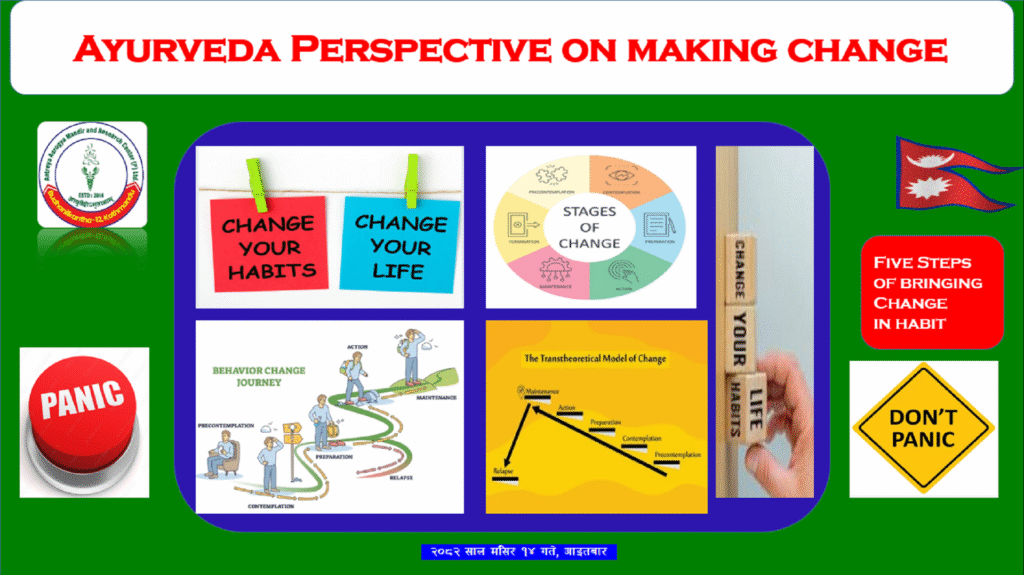
Five Steps of bringing Change in habit According to Public Health Concept
Introduction
Behavioral change is the foundation of effective public health interventions. Whether the goal is reducing non-communicable diseases, improving hygiene, or building mental resilience, people move through predictable stages before fully adopting a new habit.
The five steps of change according to the public health concept provide a science-backed roadmap to understand and influence this process. These steps help clinicians, health educators, and policymakers design better programs that align with how people naturally change.
Pre-contemplation: The Stage of Unawareness
During pre-contemplation, individuals:
Do not recognize their behavior as a problem
Avoid information related to the risk
Feel no motivation to change
Public Health Strategy:
Awareness campaigns
Community education
Personalized risk communication
Storytelling and testimonials
This stage is dominated by denial, lack of knowledge, and low perceived vulnerability, emphasizing the need for insightful education.
Contemplation: Awareness and Ambivalence
Here, people acknowledge the problem but feel conflicted about changing.
They think:
“I know smoking is harmful, but quitting is hard.”
“I want to exercise, but I don’t have time.”
Public Health Strategy:
Motivational interviewing
Risk–benefit discussions
Promoting positive outcomes
Emotional and cognitive nudges
The goal is to transform awareness into intention.
Preparation: Getting Ready for Change
At this stage, individuals begin planning:
Seeking information
Setting goals
Gathering resources
Making small changes
Consulting health professionals
Public Health Strategy:
Goal-setting workshops
Skill-building sessions
Behavior change counselling
Social support mobilization
Preparation builds the confidence and capacity needed to take action.
Action: Implementing the New Behavior
This is the most visible stage because individuals actively modify their behavior. Examples include:
Reducing salt intake
Starting daily yoga or walking
Avoiding tobacco and alcohol
Practising hand hygiene
Following Ayurveda lifestyle changes
Public Health Strategy:
Reinforcement messages
Regular follow-ups
Health coaching
Mobile reminders and digital support
Community wellness programs
Consistency and positive feedback are key in this phase.
Maintenance: Sustaining the Change
Maintenance focuses on preventing relapse and turning the behavior into a lifestyle. Individuals at this stage:
Have adopted the new behavior for 6 months or more
Develop coping strategies
Stay motivated through positive results
Avoid triggers
Public Health Strategy:
Long-term follow-up
Peer support groups
Environmental restructuring
Reward systems
Continued education
The goal is long-term stability, helping individuals integrate the behavior into daily life.
How to Change the Reflex Setting of a Person: A Scientific & Holistic Guide based on Medical Physiology

Introduction
Human reflexes are automatic, rapid, involuntary responses designed for protection and survival. But not all reflex patterns support a healthy life. Stress reactivity, panic responses, anger bursts, emotional withdrawal, overeating, and habitual fear are also forms of conditioned reflexes.
The good news: Reflex settings can be changed.
Modern neuroscience, psychology and Ayurveda lifestyle principles all agree that the nervous system has the capacity to retrain itself through awareness, repetition, and environmental restructuring.
This article explains how to change the reflex setting of a person step-by-step, based on evidence-backed methods.
Understand the Existing Reflex Pattern
Before modifying reflexes, we must first recognize:
What triggers the reflex?
What is the automatic reaction?
How does the body respond?
What thought or emotion follows?
Public Health & Neuroscience Approach:
Stress triggers → sympathetic reflex
Safety signals → parasympathetic reflex
Tools:
Journaling
Observation
Heart-rate monitoring
Professional assessment
Understanding the baseline reflex setting is essential for meaningful change.
Introduce Awareness-Based Interruption
To change reflexes, one needs to interrupt the habitual cycle. Awareness slows down automatic reactions.
Techniques include:
Mindfulness meditation
Focused breathing
Grounding techniques (5-4-3-2-1 sensory method)
Body scan relaxation
Ayurveda’s Sattvik mind training
These create a pause, allowing the brain to shift from the reflexive limbic system to the logical prefrontal cortex.
Reprogram the Nervous System through Repetition
Neuroplasticity proves that “neurons that fire together, wire together.”
To replace an old reflex, a new, healthier response must be introduced repeatedly.
Examples:
Replace panic reflex → deep breathing reflex
Replace anger reflex → pause-and-observe reflex
Replace stress-eating reflex → hydration or mindful pause
Replace overreaction reflex → grounding breath
Repeated exposure + repeated correction = reprogrammed reflex.
Public Health Principles:
Positive reinforcement
Consistency
Habit stacking
Behavioral nudges
Cue-removal strategies
With consistency, the nervous system adopts the new pattern as the default reflex.
Strengthen the Parasympathetic System
Most unhealthy reflexes come from an overactive sympathetic system (fight-or-flight).
Changing reflex settings requires strengthening the parasympathetic system.
Proven techniques:
Slow nasal breathing
Yoga and pranayama
Meditation and silence sitting
Nature exposure
Warm water bathing
Self-abhyanga (Ayurveda oil massage)
Vedic chanting and mantras
Adequate sleep
A strong parasympathetic system naturally lowers stress reactivity and rewires emotional reflexes.
Cognitive Restructuring (Changing Internal Interpretation)
Reflexes are not only physical—they are emotional and cognitive.
Thought patterns affect reflex patterns.
Use:
Cognitive Behavioral Therapy (CBT)
Rational thinking exercises
Journaling
Affirmation rewiring
Ayurveda’s Sadvritta and Achara Rasayana
Changing the meaning we assign to experiences transforms the reflexive reaction.
Use Environmental Modification
Environment powerfully shapes reflexes.
Changing surroundings changes habitual responses.
Examples:
Reducing noise in living/working space
Creating calming routines
Removing triggers
Adding reminders and positive cues
Keeping calming music
Surrounding with supportive people
A supportive environment stabilizes new reflex patterns.
Behavioral Reinforcement and Positive Feedback
The brain learns reflexes through reward pathways (dopamine system).
To change reflex settings:
Reward desired behavior
Celebrate small improvements
Track progress visibly
This strengthens the new pathway.
Practice Stress-Inoculation and Controlled Exposure
Using graded exposure, the nervous system can be trained to respond calmly to old triggers.
For example:
Someone with a panic reflex can be exposed to minimal controlled triggers while practising calm breathing
Someone with anger reflex can rehearse calm responses in imagined situations
This reduces hypersensitivity and builds resilience.
Ayurveda Approach to Reflex Rebalancing
Ayurveda teaches that reflexes emerge from a person’s Manasika Prakriti and Guna (Sattva, rajas, Tamas).
To change reflexes:
Increase sattva through diet and lifestyle
Reduce rajas (restlessness)
Reduce Tamas (inertia)
Helpful practices:
Sattvik food
Warm light meals
Brahmamuhurta meditation
Dinacharya
Avoiding over-stimulation
Manovaha Shrota-balancing herbs—like Brahmi, Shankhpushpi, and Ashwagandha (under supervision)
Holistic discipline accelerates reflex transformation.
Conclusion
Helping loved ones with behavioral imbalance and panic tendencies requires empathy, emotional intelligence, and consistent support. By combining compassionate communication, grounding techniques, and Ayurveda lifestyle principles, you can guide them toward a more stable, peaceful, and emotionally balanced life.
Understanding the five steps of change in public health empowers practitioners to design effective interventions tailored to each stage. Whether addressing obesity, mental health, substance use, or lifestyle disorders, this model ensures that public health messages are delivered at the right time and in the right way.
It bridges the gap between awareness and sustained, healthy behavior, helping communities flourish.
Changing the reflex setting of a person is completely possible through a structured approach combining awareness, repetition, environment, nervous system optimization, and cognitive restructuring.
With consistent practice, a person can transform automatic reactions into calm, thoughtful, health-promoting responses.
This is the foundation of behavioral mastery, emotional strength, and long-term health.
Help loved ones with behavioral imbalance Help loved ones with behavioral imbalance Help loved ones with behavioral imbalance Help loved ones with behavioral imbalance Help loved ones with behavioral imbalance Help loved ones with behavioral imbalance Help loved ones with behavioral imbalance Help loved ones with behavioral imbalance Help loved ones with behavioral imbalance Help loved ones with behavioral imbalance Help loved ones with behavioral imbalance Help loved ones with behavioral imbalance Help loved ones with behavioral imbalance Help loved ones with behavioral imbalance Help loved ones with behavioral imbalance Help loved ones with behavioral imbalance Help loved ones with behavioral imbalance Help loved ones with behavioral imbalance Help loved ones with behavioral imbalance Help loved ones with behavioral imbalance Help loved ones with behavioral imbalance Help loved ones with behavioral imbalance Help loved ones with behavioral imbalance Help loved ones with behavioral imbalance