

Pashupatinath Temple Nepal
Table of Contents

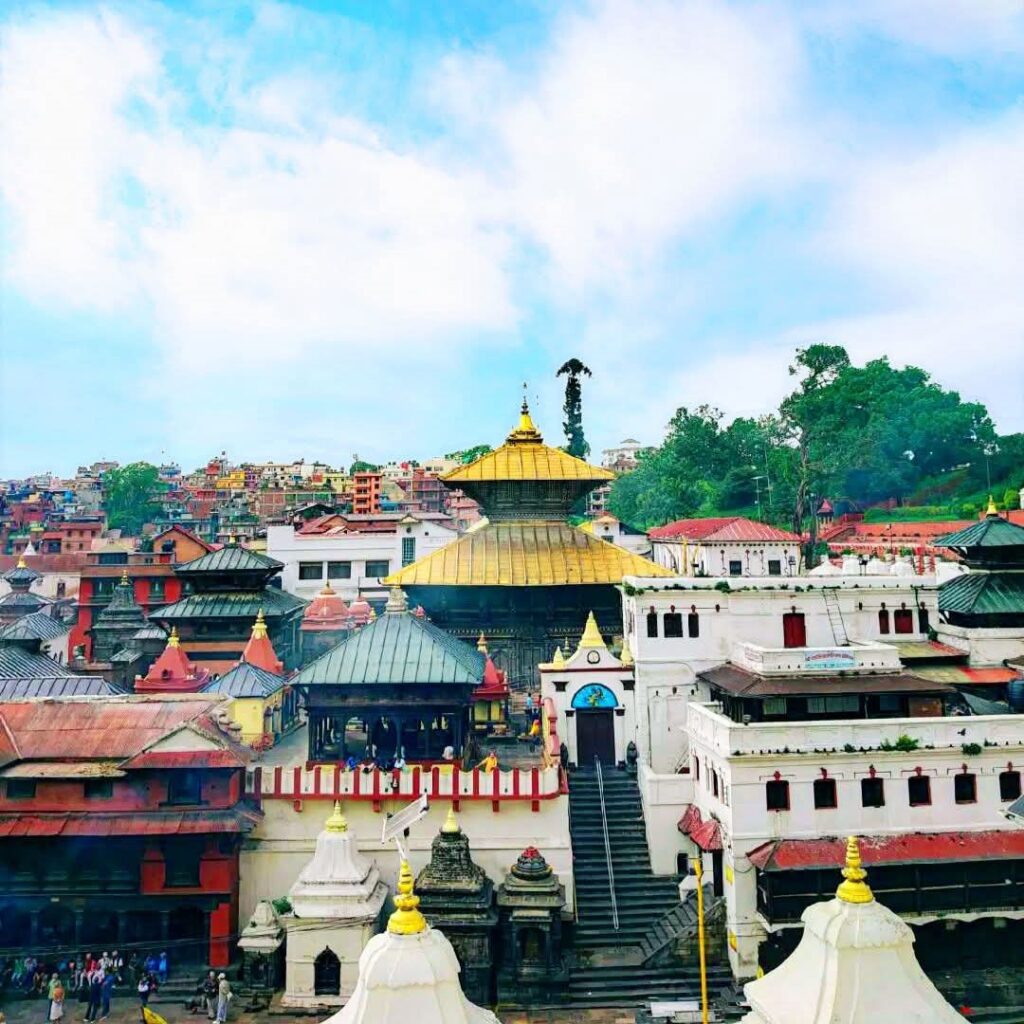
Pashupatinath Temple is one of the most sacred and ancient Hindu temples dedicated to Lord Shiva, located on the banks of the holy Bagmati River in Kathmandu, Nepal. It is a spiritual, cultural and historical icon of Nepal and has been listed as a UNESCO World Heritage Site since 1979.
Historical and Mythological Background
The origin of Pashupatinath is deeply rooted in Hindu mythology. According to the Shiva Purana and other scriptures, this place is believed to be where Lord Shiva manifested as Pashupati – the “Lord of all beings.” It is said that Shiva once took the form of a deer and wandered in the forests of the Bagmati region; when the gods found him and tried to capture him, his horn broke into several pieces – one of which is believed to have emerged as the Jyotirlinga of Pashupatinath.
Architecture and Art
The main temple is built in the traditional Nepali pagoda style, featuring a two-tiered golden roof, silver-plated doors and richly carved wooden rafters. The sacred lingam inside has four faces symbolizing different aspects of Shiva – Sadyojata, Vamadeva, Tatpurusha, and Aghora. The temple complex extends over a large area containing hundreds of smaller shrines, ashrams and stone inscriptions. The cremation ghats along the Bagmati River are also part of the temple’s spiritual landscape, reflecting the Hindu philosophy of life, death and liberation (Moksha).
Priestly Tradition
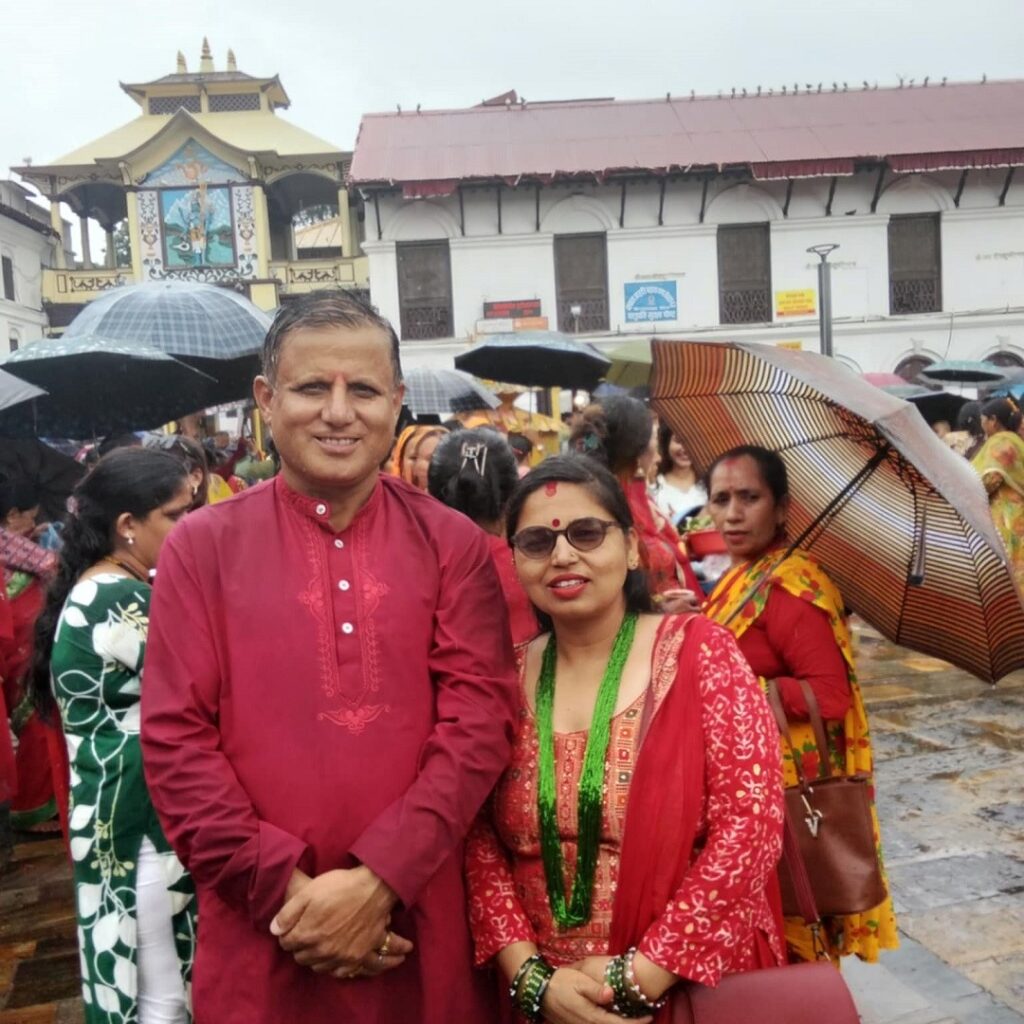
The temple’s priesthood has been traditionally held by South Indian Bhatta and Raval Brahmins, who are highly trained in Vedic rituals. The main priest (Mool Bhatta) is the only person allowed to touch the sacred lingam during daily rituals. This system dates back centuries and symbolizes the pan-Hindu unity between Nepal and India. Periodic reforms and administrative discussions about the priesthood have occurred in modern times, but the essential spiritual traditions remain intact.
Rituals, Worship and Cremation Practices
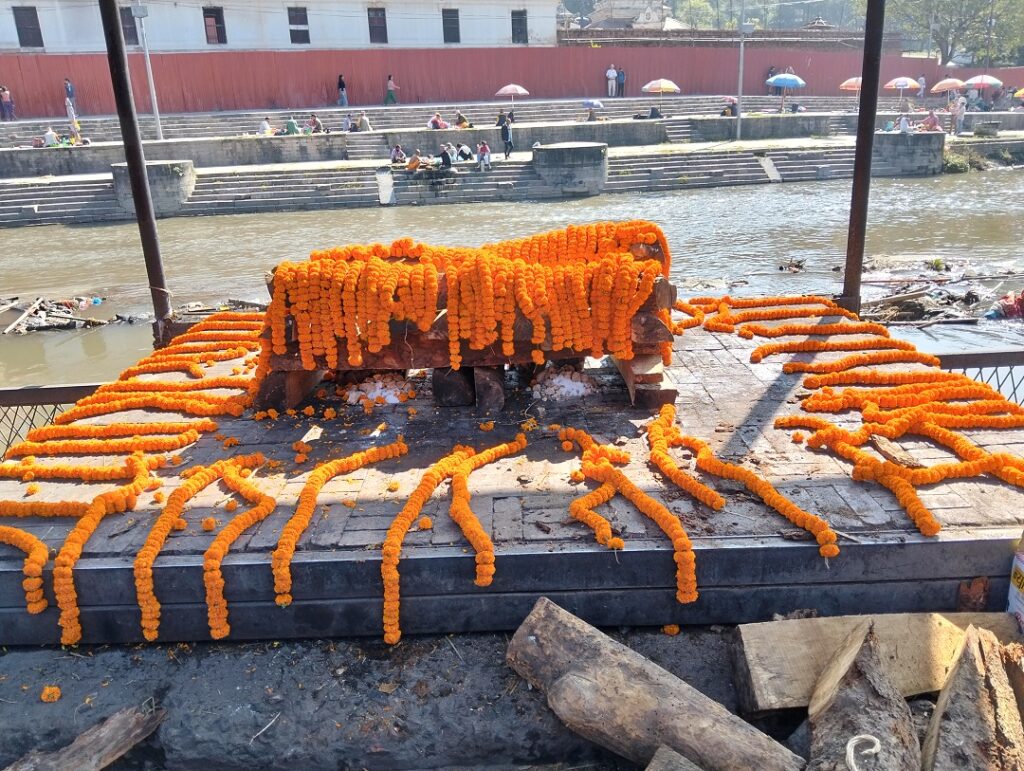
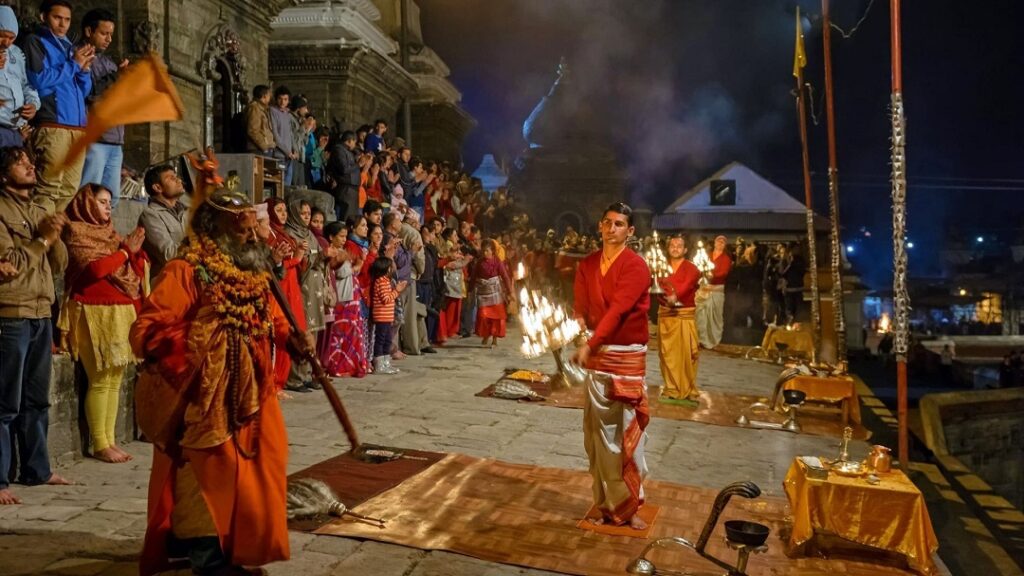
Pashupatinath is primarily devoted to Shiva worship, Rudrabhisheka (ritual bathing of the lingam), Aarati and Panchamrita offerings. The temple is also the principal site for Hindu cremation in Nepal. The Aryaghat – on the eastern bank of the Bagmati – is where funeral pyres burn daily. Families perform shraddha (ancestral rites) and Tarpana here, believing that the proximity to Pashupatinath ensures the soul’s liberation.
Festivals and Celebrations
The grandest festival celebrated here is Maha Shivaratri, when hundreds of thousands of devotees from Nepal, India, and beyond gather for night-long worship, chanting, and meditation. The temple becomes a vibrant center of faith, music, and devotion. Other festivals such as Janai Purnima, Teej, Haritalika, Bala Chaturdashi and Shravan Mondays are also celebrated with great enthusiasm.
Cultural and Interfaith Significance
Although primarily a Shaivite Hindu site, Pashupatinath holds significance for Buddhists and followers of the Nath and Tantric traditions. Many saints and yogis – including Gorakhnath and other Mahasiddhas – are believed to have meditated here. Thus, it serves as a symbol of religious harmony, spiritual diversity, and ancient philosophical unity.
Preservation and Challenges
Despite its grandeur, Pashupatinath faces challenges – environmental pollution of the Bagmati River, unregulated urban expansion, and the need for improved crowd and heritage management. As a UNESCO World Heritage site, efforts are ongoing to preserve its sanctity and cultural integrity. Cooperation between the Pashupatinath Area Development Trust (PADT), government authorities, local communities, and international bodies remains essential for its long-term conservation.
Visiting Guidelines and Etiquette
Entry Restrictions: Only Hindus are allowed inside the main sanctum, while non-Hindu visitors may observe from the eastern bank of the river.
Respectful Behavior: Modest dress and reverence are expected within the temple area.
Cremation Ghats: Visitors should be respectful while observing funeral rituals. Photography is discouraged during cremations.
Festivals: During Maha Shivaratri and Teej, the temple sees massive crowds – visitors should plan in advance and follow local guidelines for safety and decorum.
Known figures
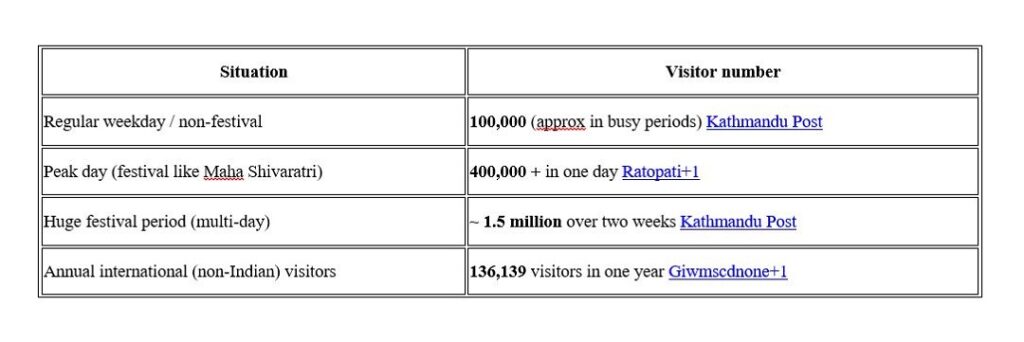
On the occasion of Maha Shivaratri in 2024: Over 400,000 devotees had visited by mid-day. Ratopati+1
On the same festival (Maha Shivaratri) in 2018: Around 700,000 people visited on that day. Kathmandu Post
On the festival in 2016: Nearly 1.5 million visitors during the two-week long festival period. Kathmandu Post
On an average busy festival day (month of Shrawan Mondays / Saturdays): The temple receives about 100,000 visitors daily, and on high peak days over 200,000. Kathmandu Post
On other festival like Teej: Around 70,000 devotees visited on one Teej day in 2018. Kathmandu Post
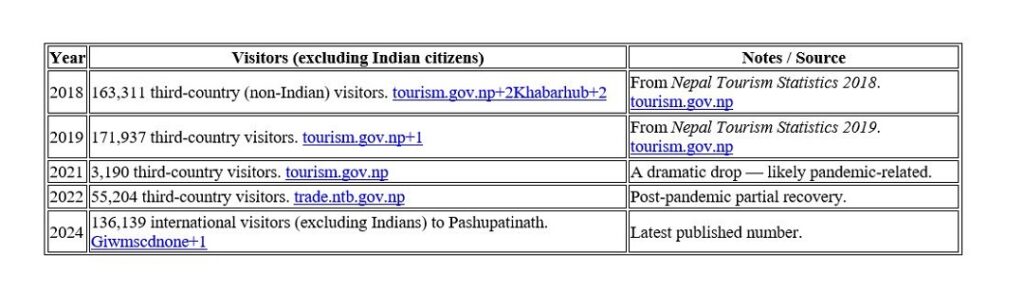
Annual figure: According to Nepal Tourism Statistics 2024, the number of international visitors (excluding Indian citizens) to Pashupatinath was 136,139. Giwmscdnone+1
Important caveats and gaps
The daily “regular” (non-festival) visitor numbers are not consistently published.
The “annual” total for all devotees (domestic + Indian visitors + foreign) is not clearly available in public sources.
Many of the numbers are for festival days, which are much higher than normal days.
The figure of 136,139 is only for foreign (non-Indian) visitors for one year, and excludes Indian citizens (who form a large proportion of devotees) and domestic Nepali visitors. So total annual footfall is much larger than that number suggests.
Different sources use different counting methods (entries, passes, estimates), so direct comparisons require caution.
Approximate summary
Known Data
Key Gaps & Considerations
The data above exclude Indian citizens, because at many pilgrimage sites the passes/entries for Indian citizens are not separately or fully recorded in the same way. Khabarhub+1
The numbers mainly refer to “third-country” (non-Nepali, non-Indian) visitors, which gives only a partial picture of overall footfall (which would include Nepali domestic devotees + Indian pilgrims + tourists).
There is no publicly easy-to-find complete monthly breakdown of total devotees (i.e., all categories) for recent years. Some month-by-month data exist for non-Indian visitors for some years. tourism.gov.np+1
Festival days (especially Maha Shivaratri) see very high visitor counts (millions over the festival period) which are not captured fully in the “annual non-Indian visitor” stats. For example: ~1.5 million people over the two-week festival in 2016. Kathmandu Post
Implications
The 136,139 figure for 2024 is only a subset (international non-Indian visitors). The actual total annual devotees (domestic + Indian + international) will be significantly higher, probably several hundred thousand or even over a million depending on year and festival.
Official published figures (visitors excluding Indian citizens)
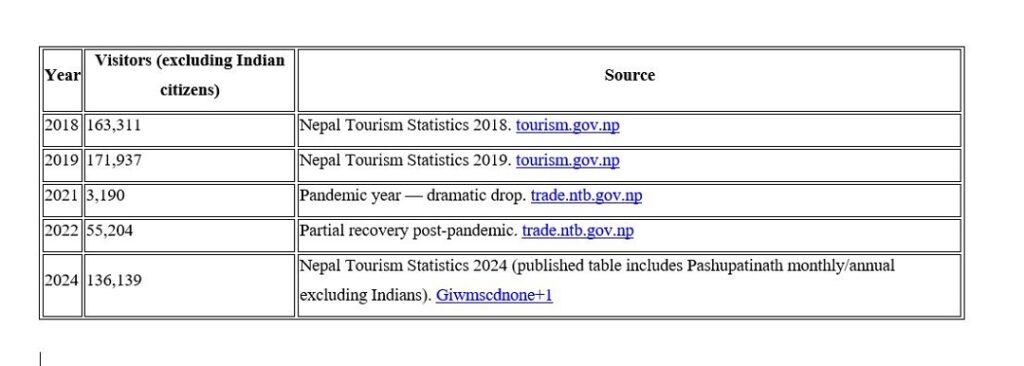
These are the figures published in Nepal Tourism / government summaries (the official “visitors excluding Indians” table is published in the Nepal Tourism Statistics reports).
What this column DOES NOT include: Indian citizens and domestic Nepali devotees (the largest groups of pilgrims at Pashupatinath are often domestic Nepalis and Indian pilgrims — both are omitted from these published “excluding Indian” counts).
Daily / festival data points (reported estimates from news / organizers)
Maha Shivaratri (festival) days — huge spikes:
2016: ~1.5 million visitors reported during the two-week festival period. mountain-hike.com
2018: ~700,000 visitors on the Maha Shivaratri day (reported). mountain-hike.com
2024 (mid-day report): 400,000+ devotees by mid-day on Maha Shivaratri. mountain-hike.com
Typical busy non-festival day (peak season / Shrawan Mondays, weekends): media reports/estimates often cite tens of thousands up to ~100,000 in busy periods; peak festival days exceed that by large margins. trade.ntb.gov.np+1
Estimates (rounded)
Pre-pandemic year (approx – using 2019 as example)
Official (non-Indian): ~172k (2019). tourism.gov.np
Conservative total estimate (all categories): ~860k (assume 5×)
Moderate estimate: ~1.7 million (assume 10×)
High estimate (heavy festival & large domestic turnout): ~3.4 million (assume 20×)
Recent rebound year (2024)
Official (non-Indian): 136,139 (2024). Giwmscdnone
Conservative total estimate: ~680k (×5)
Moderate estimate: ~1.36 million (×10)
High estimate: ~2.7 million (×20)
Conclusion
Pashupatinath Temple is not just a religious monument but a living heritage that embodies the essence of Hindu spirituality – birth, death, rebirth, and ultimate liberation. It reflects Nepal’s timeless devotion, artistic brilliance, and philosophical depth. Protecting this sacred site ensures that future generations can continue to experience its divine energy, cultural richness, and spiritual serenity.
Pashupatinath Temple Nepal Pashupatinath Temple Nepal Pashupatinath Temple Nepal Pashupatinath Temple Nepal Pashupatinath Temple Nepal Pashupatinath Temple Nepal Pashupatinath Temple Nepal Pashupatinath Temple Nepal Pashupatinath Temple Nepal Pashupatinath Temple Nepal Pashupatinath Temple Nepal Pashupatinath Temple Nepal Pashupatinath Temple Nepal Pashupatinath Temple Nepal Pashupatinath Temple Nepal Pashupatinath Temple Nepal Pashupatinath Temple Nepal

