


Table of Contents
Dynamics of Tri-Disha
“वयअहोरात्रिभुक्तानां ते अन्तमध्यादिक्रनात”
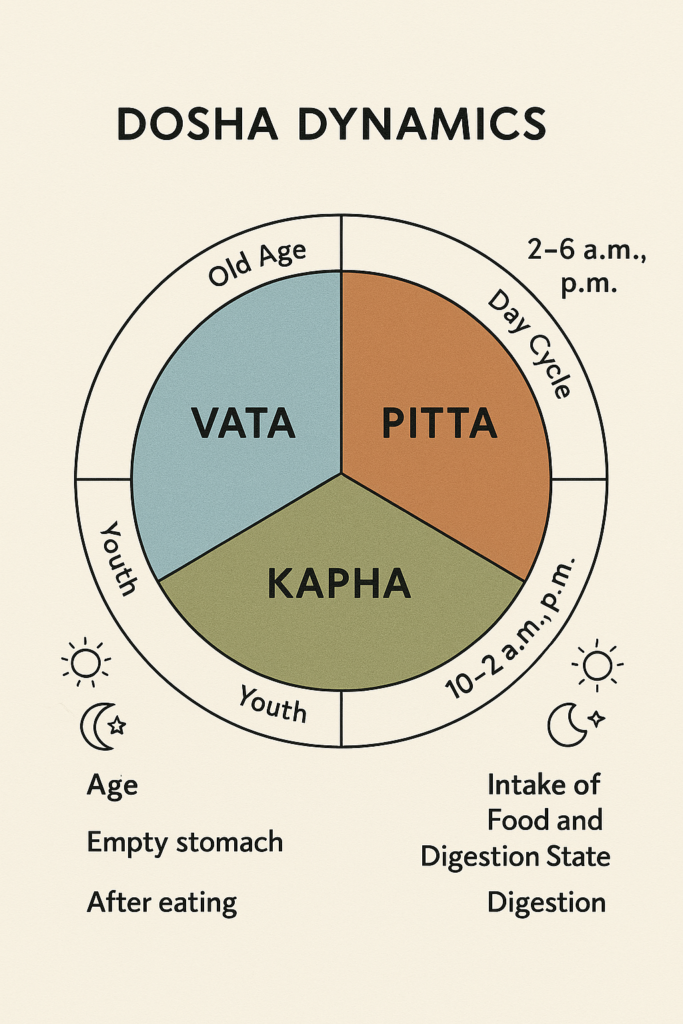
Dosha Dynamics: Kapha, Pitta, and Vata fluctuate according to Age, Day-Night Cycle, Food Intake and Digestion Process
Dosha Dynamics: An Introduction
Ayurveda, the ancient science of life, explains health through the balance of three biological energies—Kapha, Pitta, and Vata—known as the Tri-Dosha. These energies fluctuate according to age, time of the day, and different stages of digestion.
The Ayurveda principle states
“In childhood, youth, and old age, as well as in the morning, midday, and evening, and during the beginning, middle, and end of digestion, Kapha, Pitta, and Vata respectively become predominant.”
This article provides a detailed understanding of how Tridosha influences the body in various time cycles and their impact on health.
Understanding the Tri-Dosha
The three Dosha govern different physiological and psychological functions:
Kapha Dosha (Earth + Water elements)
Governs stability, growth, lubrication, and immunity.
Pitta Dosha (Fire + Water elements)
Regulates digestion, metabolism, intelligence, and body temperature.
Vata Dosha (Air + Ether elements)
Controls movement, nervous system, circulation, and elimination.
These Doshas fluctuate based on age, time of the day, and the digestion process.
Influence of Tri-Dosha in Different Stages of Life
Life Stage Dominant Dosha Characteristics
Childhood (0-16 years)
Kapha Growth, nourishment, stability, mucus production
Youth (16-50 years)
Pitta Strong digestion, energy, sharp intellect
Old Age (50+ years)
Vata Degeneration, dryness, mobility, weakness
Childhood – Kapha Dominance
Growth and tissue development require Kapha’s moisture and stability.
Children tend to have more mucus-related issues, colds, and sluggish digestion.
Their bodies are soft, plump, and slow in movement.
Youth – Pitta Dominance
Metabolism, digestion, and intelligence peak during this phase.
The body generates more heat and has high energy levels.
Skin issues like acne and temperamental mood swings arise due to Pitta imbalance.
Old Age – Vata Dominance
Dryness, weakness, joint pain, and nervous disorders become prevalent.
Mobility increases, but body strength declines.
Memory loss, anxiety, and digestive issues become common.
Daily Dosha Cycle
Influence of Time on Tri-Dosha
The body’s biological clock follows a 24-hour cycle, where each Dosha predominates at specific times:
Time of Day Dominant Dosha Effects on the Body
Morning (6-10 AM) Kapha Heaviness, slow metabolism, stability
Midday (10 AM – 2 PM) Pitta Strong digestion, peak metabolism
Afternoon (2-6 PM) Vata Alertness, mental agility, movement
Evening (6-10 PM) Kapha Preparation for sleep, relaxation
Midnight (10 PM – 2 AM) Pitta Internal detoxification, repair
Early Morning (2-6 AM) Vata Lightness, mental clarity, spiritual awareness
Morning (6-10 AM) – Kapha Period
The body is heavy, digestion is slow, and mucus levels are high.
Ideal time for physical exercise to counteract sluggishness.
Midday (10 AM – 2 PM) – Pitta Period
The body’s metabolic fire is at its peak.
Best time for the heaviest meal of the day as digestion is strongest.
Afternoon (2-6 PM) – Vata Period
The body feels lighter, and mental alertness is at its peak.
Best time for creative activities and work requiring focus.
Digestion Process and Dosha Influence
Digestion occurs in three distinct phases, each governed by a different Dosha:
Stage of Digestion Dominant Dosha Effects
Beginning of Digestion Kapha Saliva secretion, lubrication of food
Middle of Digestion Pitta Acid secretion, active digestion
End of Digestion Vata Absorption of nutrients, elimination process
Beginning Stage – Kapha Dominance
The saliva and mucus secretions moisten food, preparing it for breakdown.
Digestion is slow initially, and food is softened.
Middle Stage – Pitta Dominance
Gastric juices and digestive enzymes break down food.
Heat increases, and metabolic processes are most active.
If Pitta is imbalanced, acid reflux or hyperacidity occurs.
(End Stage)– Vata Dominance
The intestines absorb nutrients, and waste moves toward elimination.
If Vata is imbalanced, bloating, gas, or constipation can occur.
Practical Health Recommendations
For Age-Related Balance
Children: Need warm, nourishing foods to support growth and immunity.
Youth: Should focus on cooling, hydrating, and nutrient-rich diets.
Elderly: Require warm, moist, and easy-to-digest foods to counteract dryness.
For Daily Routine Balance
Eat main meals between 10 AM – 2 PM when digestion is strongest.
Exercise in the morning (Kapha time) to reduce sluggishness.
Engage in mental tasks in the afternoon (Vata time) for optimal focus.
Avoid heavy meals late at night to prevent digestive issues.
For Healthy Digestion
Chew food properly to stimulate Kapha-based lubrication.
Eat a balanced diet to avoid excessive Pitta aggravation.
Drink warm water to prevent Vata-related bloating and gas.
Conclusion
The balance of Kapha, Pitta, and Vata shifts with age, daily routine, and digestion process.
Kapha dominates childhood, morning, and the beginning of digestion.
Pitta dominates youth, midday, and the middle of digestion.
Vata dominates old age, evening, and the end of digestion.
By aligning lifestyle, diet, and daily activities according to Tri-Dosha principles, one can maintain optimal health, longevity, and disease prevention. Adapting to Ayurvedic wisdom ensures a harmonious and balanced life.
Dosha Dynamics Dosha Dynamics Dosha Dynamics Dosha Dynamics Dosha Dynamics Dosha Dynamics Dosha Dynamics Dosha Dynamics Dosha Dynamics



3f9869