Table of Contents
Rotterdam Criteria: An Introduction
The Rotterdam Criteria, established in 2003 by the European Society of Human Reproduction and Embryology (ESHRE) and the American Society for Reproductive Medicine (ASRM), provides a globally accepted diagnostic guideline for Polycystic Ovary Syndrome (PCOS).
PCOS is one of the most common hormonal disorders affecting women of reproductive age and can impact various physical and metabolic processes. The Rotterdam Criteria brought clarity and standardization in diagnosing this complex condition.
Core Diagnostic Criteria of Rotterdam
According to the Rotterdam Criteria, a diagnosis of PCOS requires the presence of at least two of the following three features:
Oligo-ovulation or Anovulation
(Infrequent or absent ovulation)
Irregular menstrual cycles
Absence of periods (amenorrhea)
Clinical or Biochemical Hyperandrogenism
(Excess androgen levels in the body)
Clinical signs: Excess body or facial hair (hirsutism), male-pattern baldness (androgenic alopecia), acne
Biochemical signs: Elevated blood androgen levels (e.g., testosterone)
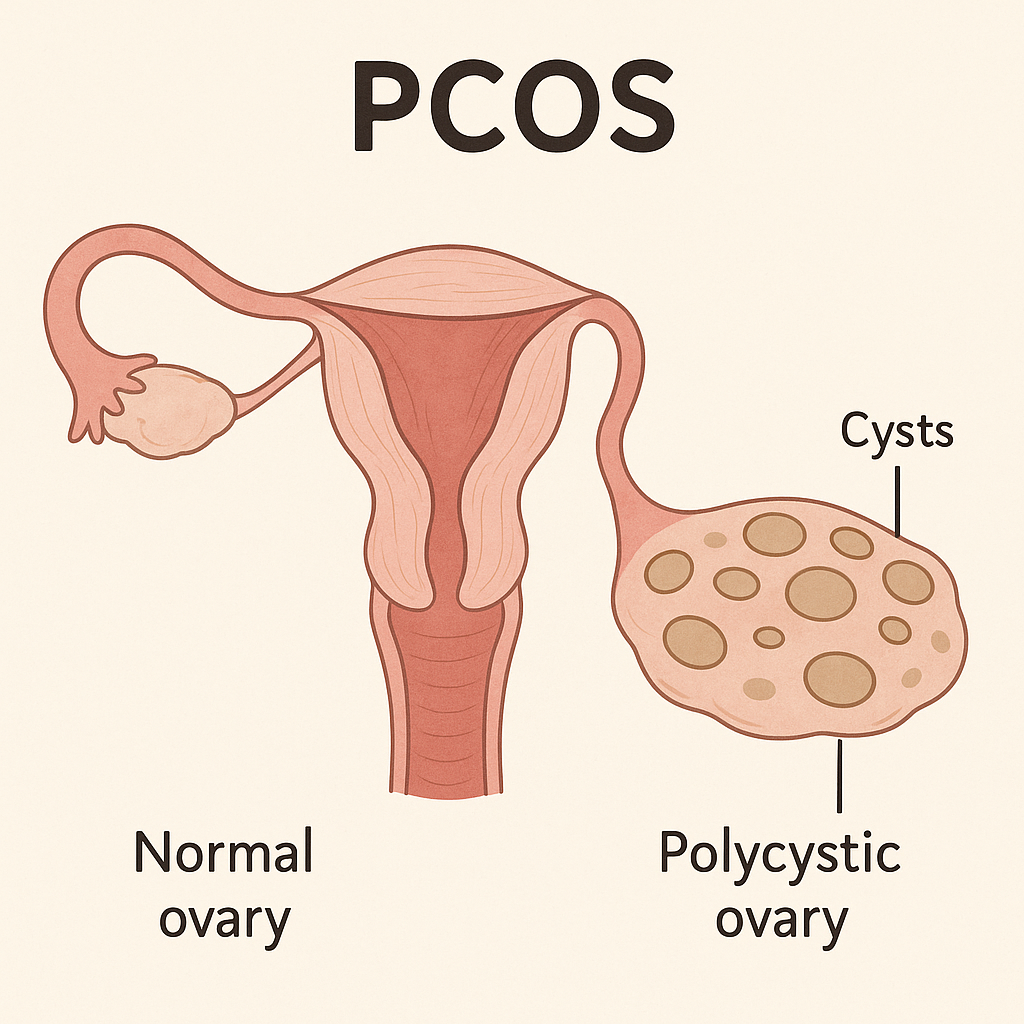
Polycystic Ovaries on Ultrasound
(Ultrasound evidence of polycystic ovaries)
Presence of 12 or more follicles (measuring 2–9 mm in diameter) in each ovary, or
Increased ovarian volume (>10 cm³)
Exclusion of Other Causes (Before Diagnosis)
Before confirming a PCOS diagnosis, other disorders that mimic its symptoms must be ruled out:
Congenital adrenal hyperplasia (CAH)
Androgen-secreting tumors
Cushing’s syndrome
Thyroid disorders (hypo- or hyperthyroidism)
Hyperprolactinemia
These conditions can also cause hyperandrogenism and ovulatory dysfunction.
Key Features and Importance of Rotterdam Criteria
Flexibility: A woman can be diagnosed with PCOS with different combinations of the criteria (e.g., irregular periods and polycystic ovaries even without excess androgen levels).
Phenotypic Classification:
The Rotterdam Criteria allows classification into different PCOS phenotypes:
Phenotype A: Hyperandrogenism + Ovulatory dysfunction + Polycystic ovaries
Phenotype B: Hyperandrogenism + Ovulatory dysfunction
Phenotype C: Hyperandrogenism + Polycystic ovaries
Phenotype D: Ovulatory dysfunction + Polycystic ovaries
Phenotypes A and B are considered more metabolically risky (higher risk for metabolic syndrome, type 2 diabetes).
Comparison with Other Diagnostic Criteria
Criteria Diagnostic Basis Year
NIH Criteria Requires both hyperandrogenism and ovulatory dysfunction 1990
Rotterdam Criteria Requires any two of three features (more inclusive) 2003
AE-PCOS Society Criteria Requires hyperandrogenism + (ovulatory dysfunction or polycystic ovaries) 2006
Compared to the NIH and AE-PCOS criteria, Rotterdam Criteria is more broad and inclusive, allowing identification of milder forms.
Diagnostic Approach under Rotterdam Criteria
Clinical History
Menstrual history, hair loss, acne, weight changes
Physical Examination:
BMI, waist-hip ratio, hirsutism scoring (Ferriman-Gallwey score)
Laboratory Tests:
Total and free testosterone
DHEAS (Dehydroepiandrosterone sulfate)
LH/FSH ratio
Prolactin and TSH to rule out other conditions
Ultrasound Evaluation
Transvaginal or pelvic ultrasound to assess ovarian morphology
Limitations of the Rotterdam Criteria
Not all hyperandrogenic cases share the same disease mechanism.
Diagnosing adolescents is challenging, as puberty-related hormonal changes may mimic PCOS.
Ultrasound thresholds have evolved over time (e.g., higher follicle count required as technology improved).
Recent Updates and Recommendations
For adolescents, a diagnosis should not be made until at least two years of persistent menstrual irregularity is observed.
Ovarian ultrasound is discouraged in girls younger than 8 years.
Lifestyle modification (diet, exercise, weight management) remains the first-line treatment approach.
Conclusion
The Rotterdam Criteria has provided a robust, multidimensional framework for diagnosing PCOS. It allows healthcare providers to identify and classify women with different expressions of the syndrome and guide individualized treatment plans.
Given that PCOS can have lifelong health implications (such as diabetes, infertility, and cardiovascular risks), early, accurate diagnosis and intervention are critical.
Continuous updating of the criteria based on new research ensures better patient outcomes in the future.
Relationship between autoimmunity & PCOS
PCOS (Polycystic Ovary Syndrome) is mainly considered a hormonal and metabolic disorder.
Autoimmunity is when the immune system mistakenly attacks the body’s own tissues.
The relationship between autoimmunity and PCOS is emerging but still not fully understood. Research shows:
Higher Autoimmune Antibodies in PCOS:
Many women with PCOS have higher levels of autoimmune markers, like:
Anti-thyroid antibodies (especially anti-TPO antibodies, leading to Hashimoto’s thyroiditis).
Anti-nuclear antibodies (ANA).
Other markers of low-grade inflammation.
Common Features:
Both PCOS and autoimmune diseases involve chronic low-grade inflammation.
Both can have a hormonal component — for example, estrogen can modulate immune responses.
Insulin resistance, common in PCOS, is also associated with immune dysfunction.
Thyroid Autoimmunity (Hashimoto’s thyroiditis) is particularly linked:
Women with PCOS have a much higher chance of developing thyroid autoimmunity compared to women without PCOS.
Thyroid dysfunction can worsen PCOS symptoms like weight gain, infertility, and irregular periods.
Possible Theories
Shared genetic predisposition (certain HLA types linked to both).
Hormonal imbalance (elevated androgens in PCOS might alter immune system behavior).
Environmental factors like stress, infections, or diet may trigger both conditions.
In short:
PCOS is not classified as an autoimmune disease itself, but there is a significant overlap, especially with autoimmune thyroid diseases and systemic inflammation.